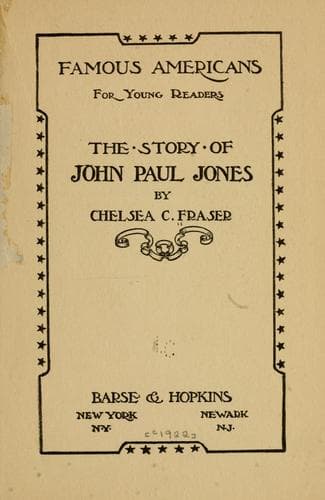
The Story of John Paul JonesFraser, Chelsea Curtis
History
The Story of John Paul Jones
Fraser, Chelsea Curtis
Jones, John Paul, 1747-1792
However, the ability to shoot was really more a matter of necessity than
an accomplishment in those days. Scattering bands of the Rappahannock
Indians often stole down stream to the holdings of the Scotch-Irish
planters along the tidewater shores, and when opportunity offered, ran
off portions of their live stock, or even sent a wicked arrow through an
unwary white man. In her scrolled coach, creaking and swaying on its
great hinges and leather straps, milady never took her airings down the
rough sandy roads without a guarding retinue of armed slaves and whites.
Nor did men themselves venture forth in the fastnesses without their
fingers playing about hammer and trigger, ever ready to throw up the
former at the slightest suspicious sight or sound, ready to pull the
latter when they became convinced that such a procedure was warranted.
Young Paul Jones enjoyed his new life to the utmost. The constant peril
from the redskins, the exciting brushes which he and old Duncan Macbean
had with some of them on different occasions, the thrilling hunts in the
forest, all went to satisfy his active, adventure-loving nature. On the
other hand, he had plenty of spare time in which to gratify his
ambitions for study, for becoming a man of power in his own section as
well as in the affairs of the new nation. He continued to study from
books, perfected his knowledge of the French and Spanish languages, and
even traveled over the Colonies quite extensively. He entertained
lavishly at home. His gallantry and courtesy made him very popular.
In his trips away from home he met many prominent statesmen of the time,
and renewed friendships with others whom he had previously met. Among
the latter was Joseph Hewes, with whom he was unusually intimate. Other
noted men of his acquaintance were Thomas Jefferson, Philip Livingston,
George Washington, Benjamin Franklin, the Lees, and Robert and
Gouverneur Morris.
For some time the Colonists had been growing more and more restless
under the burdensome taxes and conditions imposed upon them by England,
the mother-country. The governors she appointed seemed to deal with the
people unjustly, even cruelly at times. Protests did no good. If one
official was removed a worse one was put in his place. So life in the
new land, instead of flourishing, became a burden.
Bitterness began to creep into the voices of the Colonists when they
talked of Great Britain. The man who thought conditions all right was
frowned upon by the majority and called a "Tory." He was told either to
keep his silence, or go back across the seas. The majority--the
"Whigs"--did not want such men howling for the king on the virgin ground
which they had come hundreds of miles to settle and keep free from the
fetters of aristocratic rulers and their smothering taxes.
Public-domain text, read in full here on John Shaqi.
Reviews
Reviews
No reviews yet
Be the first to share your thoughts on this work.
Join the Discussion
Join the discussion
Sign in to leave a comment or review.
Sign InorCreate an account