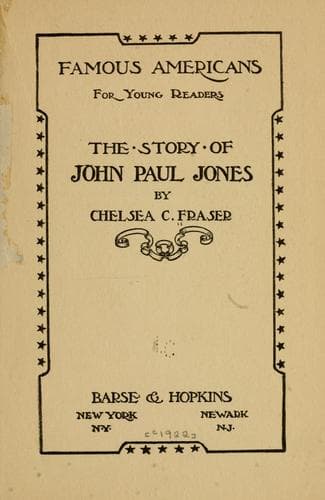
The Story of John Paul JonesFraser, Chelsea Curtis
History
The Story of John Paul Jones
Fraser, Chelsea Curtis
Jones, John Paul, 1747-1792
Welcomed home with unusual acclaim, Paul Jones found that during his
absence two things had happened which vitally concerned him. One thing
was the ravaging of his plantation by the British. His fine buildings
now lay in ashes, he was told. His splendid heifers had gone to satisfy
the appetites of the raiding soldiers under Lord Dunmore. His slaves,
who had become to him "a species of grownup children," had been carried
off to die under the pestilential lash of cruel overseers in Jamaican
canefields, while the price of their poor bodies swelled the pockets of
English slave-dealers. To his great pleasure, however, he learned that
his own overseer, canny old Duncan Macbean, had gotten away and joined
General Morgan's riflemen, presumably there to wreak vengeance on the
Red-coats with John Paul's own trusty rifle.
This was indeed a hard blow to the young captain who, in commenting upon
it, wrote to Mr. Hewes: "It appears that I have no fortune left but my
sword, and no prospect except that of getting alongside the enemy."
The second bit of news was the belated notification that, while he was
away on his cruise, Congress, on October 10, 1776, had made him a
commissioned captain in the United States Navy. It might be expected
that such an announcement would be very gratifying to him, but not so.
Paul Jones received it with more bitterness of spirit than pleasure, for
he was only number eighteen in the list of appointees. This was an
injustice which he never forgot, and to which the sensitive fellow
referred all through his subsequent life. He thought he ought to have
been not lower than sixth in rank, because, by the law of the previous
year, there were only five captains ahead of him. In the meantime, too,
he had done good service, while the new captains ranking above him were
untried.
If Paul Jones had a failing it was that of desire for prestige. Rank was
to him a passion, not merely because it would enable him to be more
effective, but for its own sake. He liked all the signs of
display--titles, epaulets, medals, busts, marks of honor of all kinds.
"How near to the heart of every military or naval officer is rank, which
opens the door to glory!" he wrote. But, mind you, Paul Jones did not
have the "swelled head." He never once over-estimated his abilities,
inwardly or outwardly; and he desired fame because he knew he was
entitled to it. If the reward failed to come after he had qualified for
and performed the service, he felt cheated--just as the day-laborer
feels cheated when he does his task and is not paid his wage.
Public-domain text, read in full here on John Shaqi.
Reviews
Reviews
No reviews yet
Be the first to share your thoughts on this work.
Join the Discussion
Join the discussion
Sign in to leave a comment or review.
Sign InorCreate an account