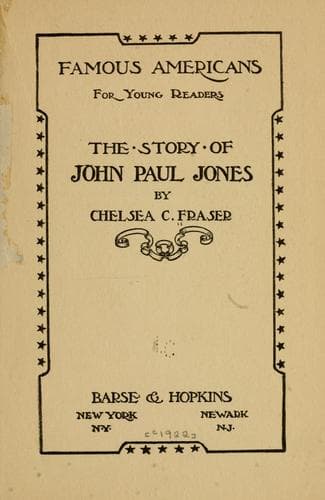
The Story of John Paul JonesFraser, Chelsea Curtis
History
The Story of John Paul Jones
Fraser, Chelsea Curtis
Jones, John Paul, 1747-1792
To his previous acquaintance with the Duc and Duchesse De Chartres there
is no doubt that Paul Jones owed his introduction at this time into
French society. The Duchesse herself had been, before her marriage, the
richest heiress in France. While her husband was a spendthrift, and a
man of lax morals generally, she was highly respected in all
communities. This noble family lived in a charming chateau, with even
more charming gardens, on the outskirts of Paris, and as soon as they
heard of the arrival of the already famous Scotch captain they sent him
an urgent invitation to call.
This he did. An enjoyable meeting resulted, and he was royally
entertained. Later, at a ball given in his honor and attended by the
élite of the social world, he met a beautiful young lady named Aimée de
Telusson, the adopted daughter of King Louis XV. Mademoiselle De
Telusson, after the king died, had been supported by a pension from the
monarch's court, and had lived with her protectoress, Madame De Marsan,
under the patronage of several great ladies, of whom the Duchesse De
Chartres was one.
Paul Jones was greatly fascinated with the fair Aimée, a feeling which
she seemed to reciprocate. As they became better and better acquainted
she fairly idolized him, and on his part he thought her the most perfect
specimen of womanhood he had ever seen. Although he must have known that
she was very much in love with him, this gallant seaman who was admired
by all the people of France, never declared his own love to her.
Dr. Franklin wished to keep Paul Jones in European waters, there to
harass the British shipping. On the other hand Lee, who for some reason
entertained a jealousy and dislike for the Scotchman, was bent on
getting him back in American waters as soon as he could. Silas Deane,
the third commissioner, was a nonentity, with little voice in the
matter. However, Dr. Franklin had his way; he thundered forth his orders
that Paul Jones was to stay on that side of the sea--and Paul Jones
stayed. To say that he was grateful to the stout-hearted, venerable
statesman is saying no more than the truth.
After some delay Dr. Franklin advised him that arrangements had been
completed by the commission for him to convoy a number of American
merchant vessels from Nantes into Quiberon Bay, where a large French
fleet, under Admiral La Motte Picquet, lay waiting with the intention of
sailing for America. Such protection by French warships a week earlier
would have been a distinct breach of neutrality, but now the
much-talked-of "Treaty of Alliance" had been made between France and
America, and henceforth France could not only openly sympathize with the
new Republic but could take up arms in her behalf.
Of course Paul Jones was glad at this turn of events. He was pleased for
his country's sake; pleased for his own sake, because the situation
promised easier working out of his plans.
Public-domain text, read in full here on John Shaqi.
Reviews
Reviews
No reviews yet
Be the first to share your thoughts on this work.
Join the Discussion
Join the discussion
Sign in to leave a comment or review.
Sign InorCreate an account