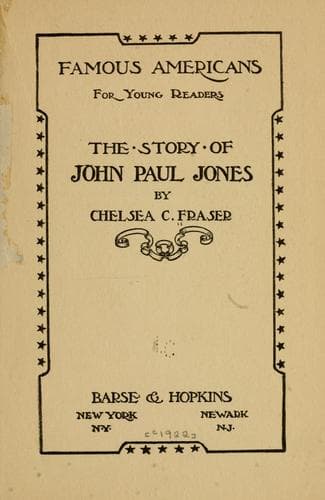
The Story of John Paul JonesFraser, Chelsea Curtis
History
The Story of John Paul Jones
Fraser, Chelsea Curtis
Jones, John Paul, 1747-1792
For some time Benjamin Franklin, knowing the need of supplies for
Washington's army, had been soliciting Paul Jones to take command of the
_Ariel_ and transport such goods from France to America. But the Scotch
commodore, dissatisfied with the humbleness of a command on such a small
sloop, had held off stubbornly, hoping that in the meantime a ship of
greater caliber and importance would be presented to him. Honors
bestowed upon him by the King of France, wherein he had been presented
with the Royal Order of Military Merit and a beautiful gold sword,
seemed to have increased his native unbounded ambitions and to have
almost spoiled him for anything but the most exalted of offices.
But on October 8, 1780, he finally sailed away in the _Ariel_, having a
goodly number of his old crew with him, including his valiant young
Indian friend Wannashego, who was now eager to see his home country and
people, from whom he had been away just one month short of three years.
The young Narragansett's muscles were like steel bands now, and not a
member of the _Ariel's_ crew could throw him. This had been amply
attested in the wrestling bouts which took place on the eve of the
ship's departure from L'Orient, when Commodore Jones had given an
elaborate farewell party. On this occasion the little _Ariel_ had been
bewitchingly decorated from stern to bow, the finest people of France
had been in attendance, and a wonderful mimic sham battle had been
shown, a replica of that terrible fight between the _Bon Homme Richard_
and the _Serapis_.
The little _Ariel_ arrived in Philadelphia the 18th of February, 1781,
and there her commander took affectionate leave of Wannashego. For five
years the young Narragansett Indian had fought at Paul Jones's side,
never once flinching, and therefore he seemed more like a younger
brother than a friend. At this time the Scotchman himself was
thirty-three years old.
Upon his arrival the commodore called on many of his friends, and then
proposed having an investigation of the doings of his enemy, Arthur Lee.
But his friends dissuaded him from this. With the whole country ringing
his praises, as had been the case when he left France, it was easy for
him to forgive his enemies. Congress passed resolutions in which they
complimented him for his victories and service to the States, and a most
appreciative letter was written him by the great George Washington
himself.
It now seemed to Paul Jones a favorable time to improve his rank--an
object he never lost sight of!--and on May 28 he sent a memorial to
Congress reiterating his claims to stand above the captains who had been
unjustly put ahead of him. He failed, probably on account of the
political influence of the aforesaid captains; but he was rewarded with
the command of the _America_, a fine new 74-gun ship-of-the-line then
building at Portsmouth. He at once went to Portsmouth, and worked for
weeks getting her ready for sea--only to have her turned over to the
King of France!
Public-domain text, read in full here on John Shaqi.
Reviews
Reviews
No reviews yet
Be the first to share your thoughts on this work.
Elsewhere in the archive
Join the Discussion
Join the discussion
Sign in to leave a comment or review.
Sign InorCreate an account