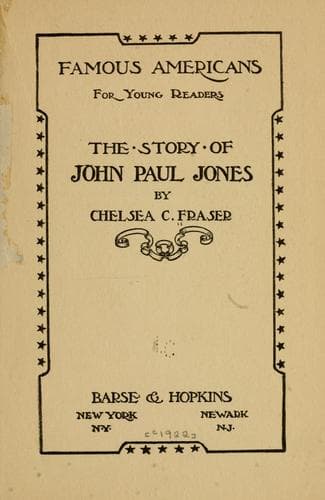
The Story of John Paul JonesFraser, Chelsea Curtis
History
The Story of John Paul Jones
Fraser, Chelsea Curtis
Jones, John Paul, 1747-1792
With undaunted energy he now attempted to get hold of the _South
Carolina_, formerly the _Indien_. But the plan failed, and he remained
without a vessel. Unable to rest, although his health had for some time
been failing, he was given consent to go off with the French fleet under
Marquis De Vaudreuil, "in pursuit of military marine knowledge," as he
termed his object. Then, in the summer of 1783, came an attack of fever.
On his recovery, he was appointed by Congress as agent to collect all
moneys due from the sale of prizes taken in European waters under his
command. In this work he showed unusual business tact and ability.
When the war closed, he began a profitable business in illuminating
oils, and continued his activities in securing prize money until all
accounts had been settled. Then Paul Jones set off for Copenhagen to
collect indemnity from the Danish government for the prizes the mad
Landais had delivered to Bergen, and which that country had turned over
to England before the declaration of hostilities between the two. He
arrived in January, 1788, and was magnificently entertained by the
court, being given a pension of 1500 crowns a year "for respect shown
to the Danish flag" while he commanded in the European seas. The
negotiations for indemnity were suspended and transferred, with his
agreement, to Paris.
When Paul Jones was in Paris, the Russian ambassador to France made a
proposition to him, through Mr. Jefferson, to take a position in the
Russian navy. Russia was then at war with Turkey, and the clever Simolin
so impressed the Scotch captain with the great deeds he might do for
the benefit of the Russian empire and the distress of the Turks, that
he at once began to maneuver for the highest command possible. He
demurred at the rank of captain-commandant, a rank equal to that of
brigadier-general in the present United States army--and maintained that
nothing less than that of rear-admiral was fitting. This was allowed.
Our hero left Copenhagen on his ill-fated Russian mission, April 11, and
made a flying and perilous trip to St. Petersburg. The Baltic was filled
with ice blocks, but at the muzzle of his pistols the intrepid Scotchman
forced two frightened and unwilling boatmen to row him across the
turbulent stream. On April 23 he was presented to the Empress, and she
conferred upon him the coveted rank of rear-admiral, to the profound
disgust of many of the English officers in the service of Russia, who
looked upon the newcomer as a red-handed and infamous pirate.
Public-domain text, read in full here on John Shaqi.
Reviews
Reviews
No reviews yet
Be the first to share your thoughts on this work.
Elsewhere in the archive
Join the Discussion
Join the discussion
Sign in to leave a comment or review.
Sign InorCreate an account