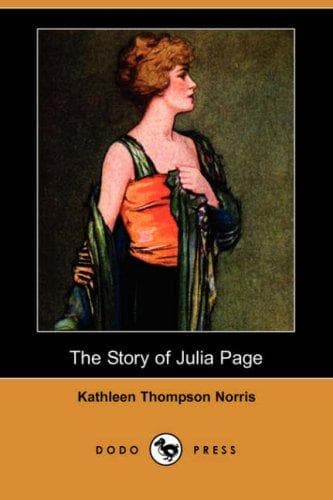
Marriage -- Fiction; Runaway husbands -- Fiction; Social settlements -- Fiction; Women -- Fiction
Julia had made an engagement with Mark for to-day, but the rehearsal
plan must interfere. She wondered how she could send him word, and
finally decided to see him herself for a moment early in the afternoon.
Mark, originally employed as office boy, pure and simple, had now made
himself a general handy man, reference and filing clerk, in the big
piano house of Pomeroy and Parke. He had all the good traits of his
race, and some of the traits that, without being wholly admirable, help
a man toward success. No slur at himself or his religion was keen enough
to pierce Mark's smiling armour of philosophy, no hours were too hard
for him, no work too menial for him to do cheerfully, nor too important
for him to undertake confidently. A wisdom far older than his years was
his. Poverty had been his teacher, exile and deprivation. When other
children were in school, repeating mechanically that many a little made
a mickle, that genius was an infinite capacity for taking pains, and
that a man has no handicaps but those of his own making, Mark _knew_ these
things, he knew that the great forces of life were no stronger than his
own two hands, and that any work of any sort must bring him to his
goal--the goal of wealth and power and position.
He knew that his father was not so clever as he was, and why. He saw
that his mother was worn out with housework and child-bearing. He did
not idealize their home, where father, mother, and seven children were
crowded into four rooms, and where of an evening the smell of cabbage
soup and herrings, of soap-suds and hot irons on woollen, of inky school
books and perspiring humanity, mingled with the hot, oily breath of the
lamp.
Yet Mark saw beyond this, too. The food was good, if coarse, the bills
were paid, the bank account grew. Some day the girls would be married,
the boys in good positions; some day the mother should have a little
country house and a garden, and the father come home early to smoke his
pipe and prune his rose bushes. Not a very brilliant future--no. But how
brilliant to them, who could remember Russia!
As for him, Mark, there was no limit to his personal dream at all. Some
day, while yet as young as Mr. Parke, he would be as rich as Mr.
Pomeroy, he would have five splendid children, like the Pomeroy
children, he would have a wife as beautiful as young Mrs. Parke. To his
beautiful Jackson Street palace the city's best people should come, and
sometimes--for a favoured few--he would play his rippling etudes and
nocturnes, his mazurkas and polonaises.
Julia Page, an unnoticed little neighbour for many years, had, just at
present, somewhat ruffled the surface of his dream. Julia was not the
ideal wife of his mind or heart; nor was she apt to grow to fill that
ideal. Mrs. Mark Rosenthal must be a Jewess, a wise, ripened, poised,
and low-voiced woman, a lover of music, babies, gardens, cooking, and
managing.
Public-domain text, read in full here on John Shaqi.
Reviews
Reviews
No reviews yet
Be the first to share your thoughts on this work.
Join the Discussion
Join the discussion
Sign in to leave a comment or review.
Sign InorCreate an account