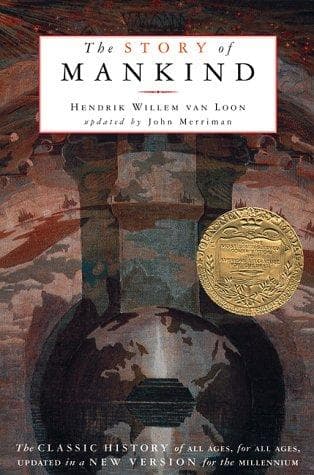
World history; World history -- Juvenile literature
In a former chapter I have told you how the idea of the Roman Empire
continued to live for a thousand years after the death of the last
Roman Emperor. It caused the establishment of a large number of
“imitation empires.” It gave the Bishops of Rome a chance to make
themselves the head of the entire church, because they represented the
idea of Roman world-supremacy. It drove a number of perfectly harmless
barbarian chieftains into a career of crime and endless warfare because
they were for ever under the spell of this magic word “Rome.” All these
people, Popes, Emperors and plain fighting men were not very different
from you or me. But they lived in a world where the Roman tradition was
a vital issue—something living—something which was remembered clearly
both by the father and the son and the grandson. And so they struggled
and sacrificed themselves for a cause which to-day would not find a
dozen recruits.
In still another chapter I have told you how the great religious
wars took place more than a century after the first open act of the
Reformation and if you will compare the chapter on the Thirty Years
War with that on Inventions, you will see that this ghastly butchery
took place at a time when the first clumsy steam engines were already
puffing in the laboratories of a number of French and German and
English scientists. But the world at large took no interest in these
strange contraptions, and went on with a grand theological discussion
which to-day causes yawns, but no anger.
And so it goes. A thousand years from now, the historian will use the
same words about Europe of the out-going nineteenth century, and he
will see how men were engaged upon terrific nationalistic struggles
while the laboratories all around them were filled with serious folk
who cared not one whit for politics as long as they could force nature
to surrender a few more of her million secrets.
You will gradually begin to understand what I am driving at. The
engineer and the scientist and the chemist, within a single generation,
filled Europe and America and Asia with their vast machines, with
their telegraphs, their flying machines, their coal-tar products. They
created a new world in which time and space were reduced to complete
insignificance. They invented new products and they made these so cheap
that almost every one could buy them. I have told you all this before
but it certainly will bear repeating.
Public-domain text, read in full here on John Shaqi.
Reviews
Reviews
No reviews yet
Be the first to share your thoughts on this work.
Elsewhere in the archive
Join the Discussion
Join the discussion
Sign in to leave a comment or review.
Sign InorCreate an account