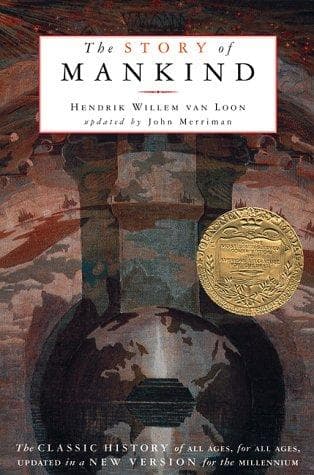
World history; World history -- Juvenile literature
As the next best solution of my difficulties, I took the type-written
pages to a number of charitable friends and asked them to read what I
had said, and give me the benefit of their advice. The experience was
rather disheartening. Each and every man had his own prejudices and his
own hobbies and preferences. They all wanted to know why, where and how
I dared to omit their pet nation, their pet statesman, or even their
most beloved criminal. With some of them, Napoleon and Jenghiz Khan were
candidates for high honours. I explained that I had tried very hard to
be fair to Napoleon, but that in my estimation he was greatly inferior
to such men as George Washington, Gustavus Wasa, Augustus, Hammurabi
or Lincoln, and a score of others all of whom were obliged to content
themselves with a few paragraphs, from sheer lack of space. As for
Jenghiz Khan, I only recognise his superior ability in the field of
wholesale murder and I did not intend to give him any more publicity
than I could help.
"This is very well as far as it goes," said the next critic, "but how
about the Puritans? We are celebrating the tercentenary of their arrival
at Plymouth. They ought to have more space." My answer was that if I
were writing a history of America, the Puritans would get fully one half
of the first twelve chapters; that however this was a history of mankind
and that the event on Plymouth rock was not a matter of far-reaching
international importance until many centuries later; that the United
States had been founded by thirteen colonies and not by a single one;
that the most prominent leaders of the first twenty years of our history
had been from Virginia, from Pennsylvania, and from the island of Nevis,
rather than from Massachusetts; and that therefore the Puritans ought to
content themselves with a page of print and a special map.
Next came the prehistoric specialist. Why in the name of the great
Tyrannosaur had I not devoted more space to the wonderful race of
Cro-Magnon men, who had developed such a high stage of civilisation
10,000 years ago?
Indeed, and why not? The reason is simple. I do not take as much
stock in the perfection of these early races as some of our most
noted anthropologists seem to do. Rousseau and the philosophers of the
eighteenth century created the "noble savage" who was supposed to have
dwelt in a state of perfect happiness during the beginning of time. Our
modern scientists have discarded the "noble savage," so dearly beloved
by our grandfathers, and they have replaced him by the "splendid savage"
of the French Valleys who 35,000 years ago made an end to the universal
rule of the low-browed and low-living brutes of the Neanderthal and
other Germanic neighbourhoods. They have shown us the elephants the
Cro-Magnon painted and the statues he carved and they have surrounded
him with much glory.
Public-domain text, read in full here on John Shaqi.
Reviews
Reviews
No reviews yet
Be the first to share your thoughts on this work.
Elsewhere in the archive
Join the Discussion
Join the discussion
Sign in to leave a comment or review.
Sign InorCreate an account