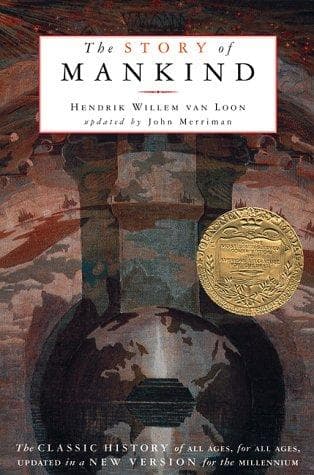
World history; World history -- Juvenile literature
Indeed, the new order of steam and iron and coal and large factories had
little use for art, for painting and sculpture and poetry and music. The
old protectors of the arts, the Church and the princes and the merchants
of the Middle Ages and the seventeenth and eighteenth centuries no
longer existed. The leaders of the new industrial world were too busy
and had too little education to bother about etchings and sonatas and
bits of carved ivory, not to speak of the men who created those things,
and who were of no practical use to the community in which they lived.
And the workmen in the factories listened to the drone of their engines
until they too had lost all taste for the melody of the flute or fiddle
of their peasant ancestry. The arts became the step-children of the
new industrial era. Art and Life became entirely separated. Whatever
paintings had been left, were dying a slow death in the museums. And
music became a monopoly of a few "virtuosi" who took the music away from
the home and carried it to the concert-hall.
But steadily, although slowly, the arts are coming back into their own.
People begin to understand that Rembrandt and Beethoven and Rodin are
the true prophets and leaders of their race and that a world without art
and happiness resembles a nursery without laughter.
COLONIAL EXPANSION AND WAR
A CHAPTER WHICH OUGHT TO GIVE YOU A GREAT DEAL OF POLITICAL INFORMATION
ABOUT THE LAST FIFTY YEARS, BUT WHICH REALLY CONTAINS SEVERAL
EXPLANATIONS AND A FEW APOLOGIES
IF I had known how difficult it was to write a History of the World, I
should never have undertaken the task. Of course, any one possessed
of enough industry to lose himself for half a dozen years in the musty
stacks of a library, can compile a ponderous tome which gives an account
of the events in every land during every century. But that was not the
purpose of the present book. The publishers wanted to print a history
that should have rhythm--a story which galloped rather than walked. And
now that I have almost finished I discover that certain chapters gallop,
that others wade slowly through the dreary sands of long forgotten
ages--that a few parts do not make any progress at all, while still
others indulge in a veritable jazz of action and romance. I did not like
this and I suggested that we destroy the whole manuscript and begin once
more from the beginning. This, however, the publishers would not allow.
Public-domain text, read in full here on John Shaqi.
Reviews
Reviews
No reviews yet
Be the first to share your thoughts on this work.
Elsewhere in the archive
Join the Discussion
Join the discussion
Sign in to leave a comment or review.
Sign InorCreate an account