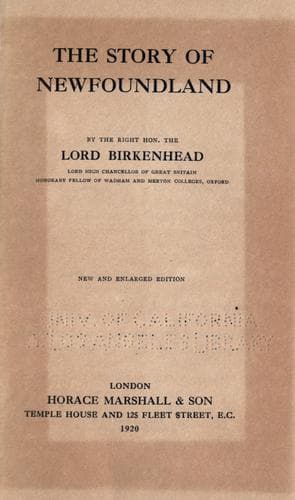
The Story of NewfoundlandBirkenhead, Frederick Edwin Smith, Earl of
History
The Story of Newfoundland
Birkenhead, Frederick Edwin Smith, Earl of
America -- Discovery and exploration -- British; Newfoundland and Labrador -- History
Newfoundland provided the pay and allowances of the Royal Newfoundland
Regiment (6,326 all ranks) and made up the difference in pay to bring
the Royal (Newfoundland) Naval Reserve to the same scale as that of
the Royal Newfoundland Regiment, besides equipping the Royal
Newfoundland Regiment before proceeding overseas.
* * * * *
FOOTNOTES:
[51] See a letter from the able correspondent of _The Times_ in
Newfoundland, November 6th, 1900.
[52] P.T. M'Grath, "Newfoundland in 1911," p. 24.
[53] This question has already been referred to several times in the
preceding pages (see especially beginning of chap. viii). It may be
added here that in March 1906, the Prime Minister of Canada stated
that the Government of Newfoundland was fully aware that the
Government of Canada was ready to entertain a proposal for the entry
of the island into the confederation.
[54] For the statement following the writer is indebted to Sir Edgar
Bowring, the High Commissioner of Newfoundland.
[55] Instead of maintaining a hospital overseas, Newfoundland
supported 301 beds in addition to 32 in Newfoundland.
CHAPTER X
THE FRENCH SHORE QUESTION
It has been impossible in the above pages to avoid reference to the
Anglo-French disputes in Newfoundland, but it seemed convenient to
postpone a detailed examination of the question to a separate chapter.
No apology is necessary for such a chapter even in a work so slight as
the present, for the French Shore question was chronically acute in
Newfoundland, and the French claims, like George III.'s prerogative,
were increasing, had increased, and ought to have been diminished. The
dispute is partly historical, partly legal, and can only be explained
by reference to documents of considerable age.
The French connection with Newfoundland was encouraged by the nearness
of Canada, and in quaint names, such as Bay Facheuse and Point
Enragee, it has bequeathed lasting reminders. For centuries the
French, like the Dutch, went on giving too little and asking too much.
By the time of Louis XIV. they had in fact established themselves--an
_imperium in imperio_--upon the south coast, and William of Orange in
the declaration of war against his lifelong enemy recited the English
grievances:
"It was not long since the French took licences from the Governor of
Newfoundland to fish upon that coast, and paid a tribute for such
licences as an acknowledgment of the sole right of the Crown of
England to that island; but of late the encroachments of the French,
and His Majesty's subjects trading and fishing there, had been more
like the invasion of an enemy than becoming friends who enjoyed the
advantages of that trade only by permission."
Public-domain text, read in full here on John Shaqi.
Reviews
Reviews
No reviews yet
Be the first to share your thoughts on this work.
Elsewhere in the archive
Join the Discussion
Join the discussion
Sign in to leave a comment or review.
Sign InorCreate an account