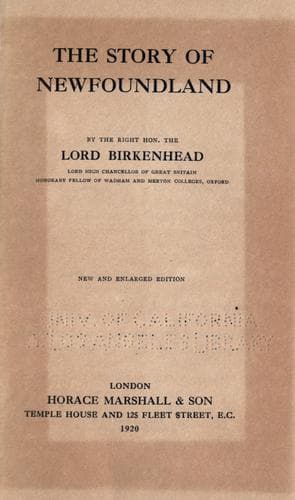
The Story of NewfoundlandBirkenhead, Frederick Edwin Smith, Earl of
History
The Story of Newfoundland
Birkenhead, Frederick Edwin Smith, Earl of
America -- Discovery and exploration -- British; Newfoundland and Labrador -- History
The Treaty of Ryswick, in 1697, contained no mention of Newfoundland,
and the French were, therefore, left in enjoyment of their possessory
claims. In 1710 the splendid genius of Marlborough had brought Louis
XIV. to his knees, and the arguments supplied by the stricken fields
of Blenheim and Ramillies, Oudenarde and Malplaquet, should have made
easy the task of English diplomacy. But from a corrupt political soil
sprang the Treaty of Utrecht, the first leading instrument in the
controversy of which we are attempting to collect the threads. The
merits of the dispute cannot be understood without a careful study of
Article 13 of the Treaty. It was thereby provided that:
"The island called Newfoundland, with the adjacent islands, shall from
this time forward belong of right wholly to Britain, and to that end
the town and fortress of Placentia, and whatever other places in the
said island are in possession of the French, shall be yielded and
given up within seven months from the exchange of the ratifications of
this Treaty, or sooner if possible, by the most Christian King to
those who have a commission from the Queen of Great Britain for that
purpose. Nor shall the most Christian King, his heirs and successors,
or any of their subjects, at any time hereafter lay claim to any right
to the said island and islands, or to any part of it or them. Moreover
it shall not be lawful for the subjects of France to fortify any place
in the said island of Newfoundland, or to erect any building there,
besides stages made of boards, and huts necessary and useful for
drying of fish, or to resort to the said island beyond the time
necessary for fishing and drying of fish. But it shall be allowed to
the subjects of France to catch fish and to dry them on land in that
part only, and in no other besides that, of the said island of
Newfoundland, which stretches from the place called Cape Bonavista to
the northern point of the said island, and from thence, running down
by the western side, reaches as far as the place called Point Riche.
But the island called Cape Breta, as also all others, both in the
mouth of the River St. Lawrence and in the Gulf of the same name,
shall hereafter belong of right to the French, and the most Christian
King shall have all manner of liberty to fortify any place or places
there."
The Treaty of Paris, in 1763, confirmed this arrangement, and twenty
years later the Treaty of Versailles contained the following provision
upon the subject:
Public-domain text, read in full here on John Shaqi.
Reviews
Reviews
No reviews yet
Be the first to share your thoughts on this work.
Elsewhere in the archive
Join the Discussion
Join the discussion
Sign in to leave a comment or review.
Sign InorCreate an account