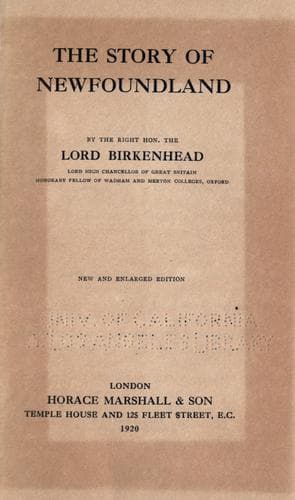
The Story of NewfoundlandBirkenhead, Frederick Edwin Smith, Earl of
History
The Story of Newfoundland
Birkenhead, Frederick Edwin Smith, Earl of
America -- Discovery and exploration -- British; Newfoundland and Labrador -- History
"The XIIIth Article of the Treaty of Utrecht and the method of
carrying on the fishery, which has at all times been acknowledged,
shall be the plan upon which the fishery shall be carried on there; it
shall not be deviated from by either party; the French fishermen
building only their scaffolds, confining themselves to the repair of
their fishing vessels, and not wintering there; the subjects of His
Majesty Britannic on their part not molesting in any manner the French
fishermen during their fishing, nor injuring their scaffolds during
their absence." But for the boundaries prescribed by the Treaty of
Utrecht (viz. those limited by Cape Bonavista and Point Riche) new
boundaries were substituted, viz., those limited by Cape St. John
round by the north to Cape Ray. The coast thus indicated came to be
known as the "French shore."
As the declaration annexed to the above treaty was often relied upon
by French diplomatists, it may be conveniently set forth in this
place:
"... In order that the fishermen of the two nations may not give a
cause of daily quarrels, His Britannic Majesty will take the most
positive measures for preventing his subjects from interrupting in any
manner by their competition the fishery of the French during the
temporary exercise of it which is granted to them.... His Majesty will
... for this purpose cause the fixed settlement which shall be found
there to be removed, and will give orders that the French fishermen
shall not be incommoded in the cutting of wood necessary for the
repair of their scaffolds, huts, and fishing boats."
The title of an Act of Parliament passed in 1782 in pursuance of this
treaty was also pressed into the service of the French contention:
"An Act to enable His Majesty to make such regulations as may be
necessary to prevent the inconvenience which might arise from the
competition of His Majesty's subjects and those of the most Christian
King in carrying on the fishery on the coasts of the island of
Newfoundland."
No material alteration in the position took place from 1782 to 1792,
and the Treaty of Peace of 1814 declared that "the French right of
fishery at Newfoundland is replaced upon the footing upon which it
stood in 1792."
On these documents a very simple issue arose. According to the English
contention their cumulative effect was to give the French a concurrent
right of fishery with themselves upon the coasts in question. It was
maintained, on the other hand, by France that her subjects enjoyed an
exclusive right of fishing along the so-called French shore.
Public-domain text, read in full here on John Shaqi.
Reviews
Reviews
No reviews yet
Be the first to share your thoughts on this work.
Elsewhere in the archive
Join the Discussion
Join the discussion
Sign in to leave a comment or review.
Sign InorCreate an account