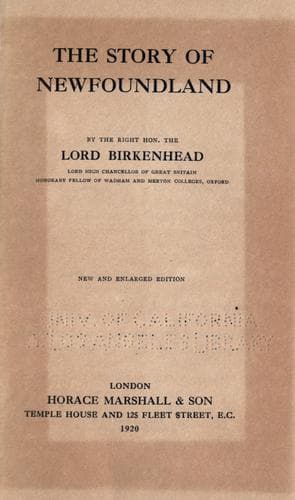
The Story of NewfoundlandBirkenhead, Frederick Edwin Smith, Earl of
History
The Story of Newfoundland
Birkenhead, Frederick Edwin Smith, Earl of
America -- Discovery and exploration -- British; Newfoundland and Labrador -- History
privileges which from the very nature of things are likely to be
injurious to parties who are thereby debarred from some exercise of
industry in which they would otherwise engage. Such rights are,
therefore, certain at some time or other to be disputed, if there is
any maintainable ground for contesting them; and for these reasons,
when negotiators have intended to grant exclusive grants, it has been
their invariable practice to convey such rights in direct,
unqualified, and comprehensive terms, so as to prevent the possibility
of future dispute or doubt. In the present case, however, such forms
of expression are entirely wanting, and the claim put forward on the
part of France is founded simply upon inference and upon an assumed
interpretation of words."
It was, in fact, as Lord Palmerston argued, a perfectly open
contention that on the authorities no exclusive right was ever given
to the French, but the demeanour of this country had been such as to
render the position difficult and unconvincing. We are, however, upon
much firmer ground when we come to close quarters with the French
claims to rights of lobster fishing. The claim was first clearly
advanced in 1888, that none but Frenchmen were entitled to catch
lobsters and erect preserving factories upon the French shore. This at
once elicited an incisive English remonstrance, in deference to which
French diplomacy had recourse to the evasion that the factories were
merely temporary. They were not, however, removed, and finally in 1889
further remonstrances by Lord Salisbury were met with the bold
contention that these factories were comprehended within the language
of the treaties. The English Government met this _volte face_ with a
feeble proposal to resort to arbitration--a proposal which the
islanders declined with equal propriety and spirit. The consequent
position was vividly and faithfully stated by Sir Charles Dilke, in a
passage which may be quoted in full:
"Instead of protecting British fishermen in the prosecution of their
lawful avocation, and resisting the new claim of the French, our
Government, after failing to enforce the claim of the French, tried to
go to arbitration upon it before a Court in which the best known
personage was to have been M. de Martens, the hereditary librarian of
the Russian Foreign Office, whose opinion on such points was hardly
likely to be impartial. Luckily, the French added a condition, the
enormity of which was such that the arbitration has never taken place,
and it may be hoped now never will.
Public-domain text, read in full here on John Shaqi.
Reviews
Reviews
No reviews yet
Be the first to share your thoughts on this work.
Elsewhere in the archive
Join the Discussion
Join the discussion
Sign in to leave a comment or review.
Sign InorCreate an account