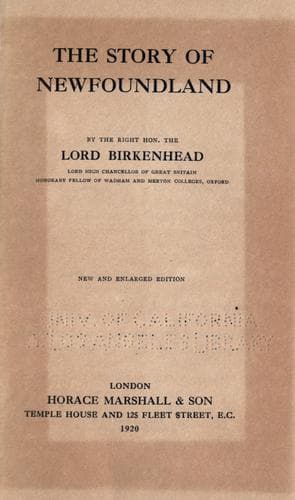
The Story of NewfoundlandBirkenhead, Frederick Edwin Smith, Earl of
History
The Story of Newfoundland
Birkenhead, Frederick Edwin Smith, Earl of
America -- Discovery and exploration -- British; Newfoundland and Labrador -- History
"The terms of the _modus vivendi_ accord to unfounded pretensions the
standing of reasonable claims, and confer upon the French the actual
possession and enjoyment of the rights to which these claims relate.
Mr Baird refused to comply with the _modus vivendi_. Sir Baldwin
Walker, commanding on the coast, landed a party of blue-jackets in
1891, and took the law into his own hands against Mr Baird, was sued
for damages, and twice lost his case.[56] There had existed an
Imperial Act under which Sir Baldwin Walker might have been protected,
but it had been repealed when self-government was granted to
Newfoundland. In the same year of 1891 a Newfoundland Act was passed,
under heavy pressure from the Home Government, compelling colonial
subjects to observe the instructions of the naval officers to the
extent of at once quitting the French shore if directed, and the Act
was to be in force till the end of 1893. The Home Government had
passed a Bill through the House of Commons, and dropped it, before it
received the Royal assent, only after the Prime Minister of
Newfoundland had been heard at the bar of both Houses and had promised
colonial legislation. The French Government have insisted that a
British Act should be passed; and Lord Salisbury, while declaring that
there ought to be a permanent Colonial Act, has always refused to
promise a British Act. To my mind, the Newfoundland people went too
far in giving up their freedom by passing the Act which I have named,
an Act to which, had I been a member of the Newfoundland Legislature,
nothing would have induced me to consent; and my sympathies are
entirely with the Newfoundlanders in their refusal to part with their
freedom, for all time, by making so monstrous a statute permanent."
The _modus vivendi_ treaty was periodically renewed by the Colonial
Legislature with a submissiveness which would have seemed excessive if
they had not been pressed with the shibboleth of Imperial interest. At
the same time, signs of restiveness were not wanting. The complaints
of the Newfoundlanders became more frequent, more insistent, and more
emphatic. They pointed out that the French virtually claimed a
monopoly of an 800-mile shore, which was entirely British of right,
that in consequence they interfered with the development of the mining
industry, and the extension of railways, and that thereby they were
seriously hampering the progress of the colony. The case put forward
by the colonists was historically strong, and there was much to be
said for the contention that they were entitled to everything they
claimed: on any view they could rightly complain of a cruel injustice,
so long as the indolence or incompetence of English diplomacy suffered
a debatable land to survive in the teeth of an undebatable argument.
Public-domain text, read in full here on John Shaqi.
Reviews
Reviews
No reviews yet
Be the first to share your thoughts on this work.
Elsewhere in the archive
Join the Discussion
Join the discussion
Sign in to leave a comment or review.
Sign InorCreate an account