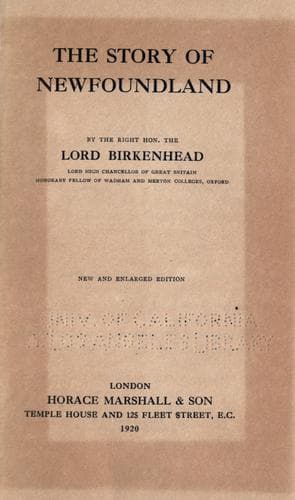
The Story of NewfoundlandBirkenhead, Frederick Edwin Smith, Earl of
History
The Story of Newfoundland
Birkenhead, Frederick Edwin Smith, Earl of
America -- Discovery and exploration -- British; Newfoundland and Labrador -- History
In August, 1898, at the request of the Newfoundland Government, a
Royal Commission was appointed by Mr Chamberlain, and sent out the
following year, for the purpose of inquiring into the whole question
of French treaty rights. A good deal of evidence was given by local
colonists of acts of French aggression, and of consequent injury in
person and property. But the report remained unpublished. Such
aggression was in keeping with the instructions issued in 1895 by the
French Premier and Foreign Minister to the commanders of the French
warships on this station: "To seize and confiscate all instruments of
fishing belonging to foreigners, resident or otherwise, who shall fish
on that part of the coast which is reserved for our use"--instructions
that amounted to an arbitrary assertion of territorial sovereignty.
And yet the actual interests of France were very meagre: thus in 1898,
on a coastline where some 20,000 Newfoundlanders were settled in 215
harbours, there were only 16 French stations and 458 men on the
800-mile shore; in 1903 only 13 stations and 402 men.[57]
In 1901 when the vexed question came once again before the
Newfoundland Legislature, the Government declared that in renewing the
_modus vivendi_ for the following year, they did so only in
consideration of the obstacles then in the way of the Imperial
Government to securing a satisfactory settlement of the whole matter.
In 1904 the Newfoundland Government refused to relax the Bait Law any
more; and France then consented to enter into the notable agreement,
which once for all abolished the inveterate grievances and
difficulties arising out of the "French shore" question. In
consideration of certain territorial privileges in West Africa, France
agreed to relinquish her rights as to landing and drying fish on the
treaty shore, which had been recognized by the Treaty of Utrecht.
French subjects injured by this arrangement were to receive such
compensation from Great Britain as would be awarded by a tribunal
consisting of one representative of each contracting party, assisted
by an umpire if necessary. The French were to enjoy the same rights as
British subjects of fishing on the coast generally, and were permitted
to take bait, which they had been forbidden to do by the Newfoundland
Act of 1886. This convention did not affect the applicability of local
law as to bait in regard to the non-treaty coast.
Public-domain text, read in full here on John Shaqi.
Reviews
Reviews
No reviews yet
Be the first to share your thoughts on this work.
Elsewhere in the archive
Join the Discussion
Join the discussion
Sign in to leave a comment or review.
Sign InorCreate an account