World War, 1914-1918 -- Naval operations -- Submarine
Note: Images of the original pages are available through
Internet Archive. See
http://archive.org/details/storyofoursubmar00bowerich
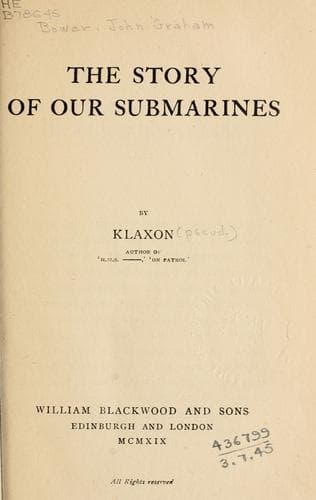
THE STORY OF OUR SUBMARINES
by
KLAXON
Author of 'H.M.S. ----,' 'On Patrol'
William Blackwood and Sons
Edinburgh and London
MCMXIX
All Rights reserved
THE STORY OF OUR SUBMARINES
I
I
There has naturally been a great deal of ink spilled during the War on
the subject of the U-boat. The British Submarines have worked unseen
and unheard of. Occasionally a few official lines have appeared in the
newspapers about them, but the very nature of the work they have been
doing has precluded any divulging of their activity. With the
permission of the Admiralty I am about to speak now of some of the work
they have done, and to give their own reports describing some of the
many occasions on which they have been in contact with the enemy.
On August 4, 1914, we had in our Submarine Service the following boats:
9 E class, 8 D class, 37 C class, 10 B class.
Of these, the B and C classes were 320 tons submerged displacement, and
were not suitable for the patrol round the mouth of the Bight. The D
and E boats were designed for that purpose, being of 600 and 800 tons
submerged displacement respectively. The B and C classes were used in
the War for local patrols, defence of the coasts and ports, and (as the
War progressed and they became obsolete), for instruction of new
entries of personnel.
Before I get on to the War itself I want to give a short description of
the entry and training of our personnel both before and after the War
began.
In peace time an officer who wished to join the Submarine Service had
first to receive a recommendation from his own Captain. He then had to
produce either a first-class certificate for his Torpedo examination
for Lieutenant, or, if he had not that qualification, a certificate
from the Torpedo-Lieutenant of his ship to the effect that he showed
special zeal in that branch of his duties. If his name was accepted it
was placed at the bottom of the candidates' list, and in due time,
after an interval which varied from year to year, he was appointed to
Fort Blockhouse, the Submarine Depot at Gosport. There the batch of new
officers were medically examined, and (the standard being high) the
unfit were weeded out and returned to their ships.
For the next three months he went through a course of practical
submarine instruction, his training period terminating in examinations
which provided another obstacle, the meshes of which prevented certain
candidates from proceeding further.
The officers of the class were then sent as "third hands" to different
boats to await vacancies as First Lieutenants. After two to four years
as First Lieutenant (the time varied with the number of new boats
built), an officer obtained command of an A boat (of 204 tons), from
which he rose by seniority to larger and more powerful commands.
Public-domain text, read in full here on John Shaqi.
Reviews
Reviews
No reviews yet
Be the first to share your thoughts on this work.
Join the Discussion
Join the discussion
Sign in to leave a comment or review.
Sign InorCreate an account