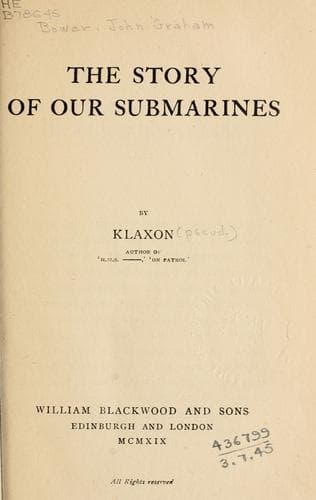
World War, 1914-1918 -- Naval operations -- Submarine
boarded the ferry and made the passage amidst a crowd of Danish sailors
and police, went to a rendezvous with a friend on arrival, changed his
clothes, and became a Norwegian merchant-ship mate of Finnish birth and
language (Finnish interpreters are generally scarce). He then caught
the first train out to Christiania, called at the Legation for a
passport, and went straight on to Bergen, changing his personality on
the way to that of "George Perkins, U.S.A.--a Marine Overseer." At
Bergen he boarded the Norwegian mail-boat for Newcastle, still posing
as an American. His histrionic abilities, however, were rather
discredited on the journey, as several fellow-passengers doubted that
he really came from the States, and one tactlessly stated that he would
have put him down as a British naval officer, "if he hadn't been told
he was an American." At Newcastle he had considerable difficulty in
establishing his identity--the sleuth instinct of a Boy Scout causing
him some trouble--but he eventually cleared his character, and reached
London on Tuesday, having broken out of prison at 7.30 P.M. the
previous Friday. The hue-and-cry started too late to catch him, and,
partly perhaps owing to Danish sympathy with this country, and also
certainly owing to his personality having become popular with the
Copenhagen people during his parole period, the chase was guided by the
Danish newspapers into several wrong directions.
On the 15th April 1915, Submarine "E 15" (Lieut.-Commander T. S.
Brodie) made the first attempt to enter the Sea of Marmora. She
entered the Dardanelles at 2 A.M., dived at 4, and at 6.45 A.M. she
struck the shore under the Turkish guns. The captain ordered all tanks
to be blown, and under a terrific fire he tried to get the boat off by
going full astern (she had bounced up the beach till her conning-tower
and hull were exposed), and the survivors reported that he had just
inquired if the hull was badly hit or not when a large shell passed
through the conning-tower, killing him instantly. Orders were given to
abandon the ship, and Lieutenants Price and Fitzgerald proceeded,
while shell after shell struck the boat, to destroy the charts and
papers. This boat was later further demolished by a gallant British
picket-boat attack. A fortnight later "A E 2" was sent up, and, as has
been told, was lost in the Marmora. The third and fourth boats, "E 11"
and "E 14" got through safely. It is interesting to read in a German
publication that the German Admiral on the spot stated later, "The
English submarines in the Marmora performed magnificently.... The
English submarine design is excellent." A German officer would not
agree with the latter part of the remark, as every nation has a
different type of boat, but certainly in the Marmora our submarine
officers preferred the E type of boat to anything else.
Public-domain text, read in full here on John Shaqi.
Reviews
Reviews
No reviews yet
Be the first to share your thoughts on this work.
Elsewhere in the archive
Join the Discussion
Join the discussion
Sign in to leave a comment or review.
Sign InorCreate an account