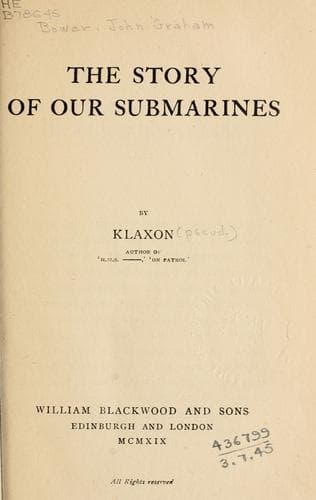
World War, 1914-1918 -- Naval operations -- Submarine
The E boat was working a "beat" ten miles to the north of the North
Dogger Bank Lightship--a dull beat, too, as in 1918 the U-boat captains
had long ago given up the idea of passing near lightships in surface
trim. The patrol was not there for enemy submarine strafing, however.
The E boat was a unit of the watching semicircle that dived eternally,
from the Haaks light off the Dutch coast to Hiorn's Reef off Jutland,
watching for a cloud of smoke to the east that would tell of the coming
of the High Sea Fleet. The boat had been on the billet two days, and
had five more to wait before she started her run home to Harwich. She
had spent the short spring night jogging about on the surface at six
knots, charging her batteries, and at 4 A.M. she slowed up and slipped
under. It was her thirtieth patrol trip, and she expected it to be as
dull as most of the others had been; there was a kind of yawning,
done-it-all-before air in the way the crew took her under that
morning, that showed, besides good training, a familiarity with
intricate mechanism that had developed into something approaching
contempt. The boat settled to her day's dive at twenty feet, her
periscope moving slowly along at a speed of about two knots, leaving a
very faint rippling line on the smooth North Sea surface. The Captain
swung the periscope round, wiped the eyepiece with a nominally clean
chamois-leather pad, and then leaned back against the diving gauge,
finishing the fag-end of a cigarette. It was still twilight in the
world above him, and the bad light, combined with the fact that
periscopes are very apt to "fog" for some minutes after diving, when
the engines are still hot enough to make the air in the boat steamy,
would prevent him seeing anything clearly for twenty minutes. It was a
rule of his to keep the early morning periscope watch himself, as he
believed that if anything exciting was going to happen it would always
occur at dawn. Certainly, as far as U-boats go, his ideas were right,
as a boat on passage is humanly liable to hold on to her surface speed
and trim as long as there is a hint of darkness left to protect her,
and in submarine war it is the one that gets under earliest that lives
longest.
Public-domain text, read in full here on John Shaqi.
Reviews
Reviews
No reviews yet
Be the first to share your thoughts on this work.
Join the Discussion
Join the discussion
Sign in to leave a comment or review.
Sign InorCreate an account