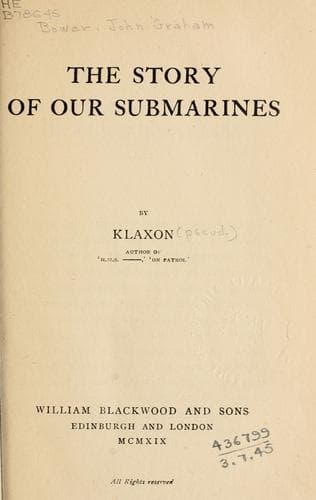
World War, 1914-1918 -- Naval operations -- Submarine
A submarine may be any kind of surface vessel, with the advantage added
to her of being able to dive. She need not necessarily be a diving boat
with a few torpedo tubes and a couple of guns. She may be anything. A
surface ship can only be one thing; you cannot have a cruiser-monitor
or a destroyer-battleship. But a submarine may be two things at once;
and a submarine can, as a result, act unsupported. Take the case of a
scouting submarine. What is the alternative? If we had no scouting
submarines we would have had to keep a ring of destroyers out to watch
the Bight. Those destroyers might, being out near the enemy's coast, be
attacked by enemy cruisers, so that it would be essential to keep our
cruisers out in support. Then if the enemy brought out--and so on--up
to the final result of our battle fleet being continuously at sea,
which would have been not only unnecessary wear and tear on the big
ships, but a good opportunity for the U-boats if they had cared to take
a chance. Take the case of the submarine mine-layer. She has the great
advantage, to begin with, of not only getting to her position unseen,
but of being able to lay her unpleasant cargo down unsuspected and
unobserved. Then, again, she does not need a supporting force to follow
her in case she meets with trouble. She does not look on a big enemy
ship as a trouble, should one interfere with her; she would rather
describe the big ship as a "gift." She is open to the usual
anti-submarine methods, and can be dealt with by destroyers, seaplanes,
and so on; but if she succumbs to their attacks--well, that is another
submarine gone, but it might have been a big surface ship.
By the nature of the German strategy our lines of design were
indicated. The chief type we needed were scouts--in other words, patrol
boats. We built these in considerable numbers, for the several types of
patrol boats we diverged into were capable of doing any of several
things. They could do the Heligoland Bight patrol, attacking the enemy
if met with, and reporting to the C.-in-C. what they saw on their
patrols; they could go out into the Atlantic to hunt U-boats on the
traffic lanes, or they could go to the Mediterranean to work in the
Adriatic. They were the general-utility craft of the Submarine Navy.
The mine-layers were of the patrol boat type, getting larger as the War
went on, but always with the torpedo-tubes (reduced in number) built
into them to allow them to become normal submarines when a chance
arose.
Public-domain text, read in full here on John Shaqi.
Reviews
Reviews
No reviews yet
Be the first to share your thoughts on this work.
Join the Discussion
Join the discussion
Sign in to leave a comment or review.
Sign InorCreate an account