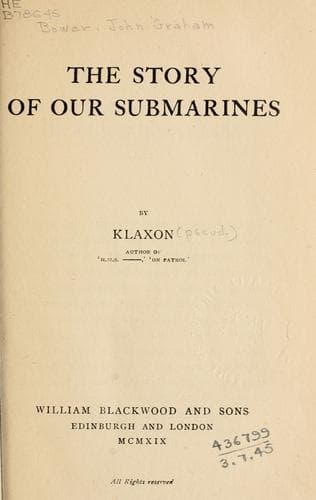
World War, 1914-1918 -- Naval operations -- Submarine
"The destruction of the enemy's means of transport in the Sea of
Marmora has been pursued throughout with the utmost regard for
humanity. Ships carrying refugees have invariably been spared, and
the crews of sailing vessels either given time to escape or rescued
at considerable inconvenience to the submarine. On many occasions
the crews of vessels destroyed have shown their surprise and
gratitude at the consideration shown to them."
The first boat to enter the Narrows was "B 11" (Lieutenant Holbrook).
She successfully torpedoed and sank the Turkish battleship
_Messudiyeh_. The outstanding fact of this feat was that the boat
was built in the summer of 1906, making her well over eight years old
when she went into the Dardanelles. Eight years is a great age for a
submarine in a Service which advances every month in the knowledge of
construction, and "B 11" was in 1914 almost ready for a final paying
off. She showed, however, that the old boats were by no means useless
if handled as they should be.
The first trip right into the Marmora was by "A-E 2" (Lieut.-Commander
Stoker). She was an Australian boat of the same type as the other E's.
She was unfortunately sunk by a destroyer in the Marmora after getting
in.[4]
[4] As I have not the despatch by me, I am postponing the
account of her passage till later.
In the Baltic also, at the beginning of the war, targets were far more
plentiful than in the North Sea. Commander Horton in "E 9" sank a
destroyer on January 29, 1915. On June 4 he sank a transport which was
protected by a destroyer screen. On July 2 he torpedoed and badly
damaged the _Prinz Adalbert_. On July 29 "E 1" (Commander Laurence)
sank a transport. On August 19 he torpedoed and damaged the _Moltke_,
incidentally causing the enemy to withdraw from the attack on the Gulf
of Riga--an attack which at the moment showed every probability of
succeeding. Later in the war the Germans renewed their attack
successfully--secure in the knowledge that the internal conditions
caused by the Revolution had prevented the British submarines from
operating. At that time we had in the Baltic four "E" Class ("E 18,"
Lieut.-Commander Halahan, having been lost at sea in May 1916 with all
hands, from a cause unknown) and four "C" Class. The latter boats had,
instead of entering the Baltic by the Sound, come in August 1916 _viâ_
the White Sea and up the Dvina river in wooden barges towed by tugs;
they came practically empty, and their batteries, etc., were replaced
in them on arrival at Petrograd. The Revolution caused such chaos that
the flotilla was practically tied to harbour after the Soviet
Government's installation. "C 27" (Lieutenant Sealy), however, was able
to torpedo a transport during the attack on Oesel, and was also
reported to have damaged one of the screening vessels. There is no
doubt that the knowledge that these submarines had been rendered
powerless enormously helped the Germans in the Baltic.
Public-domain text, read in full here on John Shaqi.
Reviews
Reviews
No reviews yet
Be the first to share your thoughts on this work.
Elsewhere in the archive
Join the Discussion
Join the discussion
Sign in to leave a comment or review.
Sign InorCreate an account