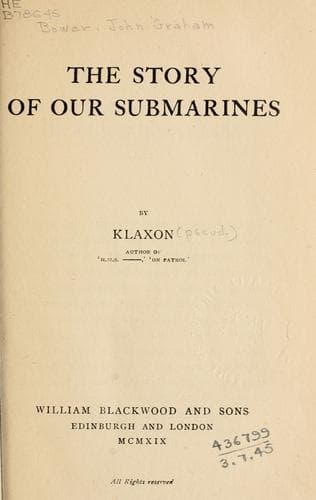
World War, 1914-1918 -- Naval operations -- Submarine
As they swung round the last river-buoy and saw the outer lightship
draw clear of the land, a destroyer overtook them, and passed on ahead
to lead them to sea. The boat was going thirty miles out to get deep
water for her hull-test, and it was not safe for a British boat to be
that distance, or even a third of that distance, from the mouth of a
British harbour unescorted, unless she was there on her war business.
This was not because of the enemy--far from it; it was to save her from
the enthusiastic but misguided attentions of the multitudes of
"Fritz-hunters" who drew no distinction between submarines of their own
or the enemy's flag. As she neared the light-vessel, the submarine
increased speed and some of the "yarning-party" on the bridge departed
below down the conning-tower. The programme included a full-speed
surface-trial which was to start from the lightship and finish at the
diving-ground, and for the next two hours the engineers and
engine-overseers were to be the only busy passengers. From the
engine-room bulkhead to the bows, the crew and officers moved to and
fro--testing, instructing, and, it should be added, grumbling
continuously, for the multitude of passengers were a considerable
handicap in the way of an efficient and (the great ideal) an unexciting
and placid diving-trial.
The inside of the boat was incredibly dirty from a naval point of view.
She had not been built at one of these yards where no workman can live
without a quid of tobacco in his cheek (in fact by the trials standard
of some yards she was clean), but it was obvious that she would take a
good month's scrubbing and polishing before she was, in her officers'
estimation, even sanitary.
At ten o'clock an order came from on deck, and a couple of sailors
ascended the conning-tower carrying a few rounds of 12-pounder
ammunition. The trials she was to do were to be complete and to
everybody's satisfaction, and the building firm, being a firm which
would sooner see their work over- than under-tested, had suggested a
few rounds from the bow-gun before the dive, with the idea that if the
gun-mounting was going to cause leaks through to the hull as a result
of recoil, it should be given the chance to do it now instead of later
when the boat was in enemy waters. A biscuit-tin was dropped, the boat
circled round, and at a range of a hundred yards the gunlayer proceeded
to miss the box completely. However, the shooting did not matter--the
gun had recoiled a few times and that was all that was required. The
fact of the gunlayer finding later that he had shipped the sights of
the H.A. gun on to his bow-gun before practice, was a merely trifling
incident among the errors that one might expect to occur on trials.
Public-domain text, read in full here on John Shaqi.
Reviews
Reviews
No reviews yet
Be the first to share your thoughts on this work.
Join the Discussion
Join the discussion
Sign in to leave a comment or review.
Sign InorCreate an account