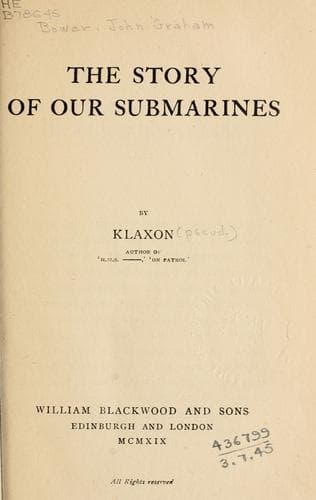
World War, 1914-1918 -- Naval operations -- Submarine
Revolutionary crews in Russian submarines gave illustrations of what
happens if democracy is carried to its limits. An English submarine
officer did a short trip in a boat belonging to the Russian Navy, and
his comment about it was that "if it had not been so serious it would
have been comic." The crew's committee had dismissed the engineer and
mechanicians for reasons of their own, with the result that furious
altercations used to go on as to the best way to start up the engines.
The results were not always successful; but the cook, who seemed to be
the only man aboard who knew how it was done, used to eventually
intervene and make the much-enduring metal get to work again. This, of
course, was at sea and near to the enemy.
Some difficulties were experienced in keeping the British submarine
sailors away from the Russians when the boats were in harbour. Captain
Cromie reported on one occasion: "I regret to report that striking
cases are becoming more frequent, chiefly due to insolence on the part
of the Russians and a growing contempt for them on the part of our
men." Our sailors had no objection to anybody's political opinions, but
they did object to a spirit of murder in substitution for a fighting
spirit. The whole of Russia at that time was in a turmoil. Bolshevism
was beginning, and the Germans were sweeping up the Russian ships and
defences as if they were empty. The Russian Naval Commander-in-Chief
went in person to assist in the defence of the Gulf of Riga. When he
and his staff arrived at Hapsal they had to walk seven versts to
Rogikoul, as the railway was on strike for vodka!
The Baltic submarine flotilla vanished with the collapse of Russia, but
it had made a great name for itself. Even during the nightmare of
revolutionary lunacy that preceded the end, it was looked on by all the
Russians as the one straightforward and efficient force that remained.
The lowest as well as the highest respected it as the symbol of honesty
and courage. During its career it had caused the greatest annoyance to
the enemy, on occasions holding up and stopping practically all traffic
from Germany to Sweden in enemy ships. The following extracts show the
way some of the work was done:--
"'E 9' (Commander Horton), October 18th, 1916, 5.50 P.M.: Chased
steamer and ordered her to stop by International Code and by
firing maxim ahead of her. She proved to be the German ship
_Soderham_ of Hamburg. Boarding party went aboard and told
crew to abandon ship, then opened up sea-cocks and exploded
demolition charges.
Public-domain text, read in full here on John Shaqi.
Reviews
Reviews
No reviews yet
Be the first to share your thoughts on this work.
Elsewhere in the archive
Join the Discussion
Join the discussion
Sign in to leave a comment or review.
Sign InorCreate an account