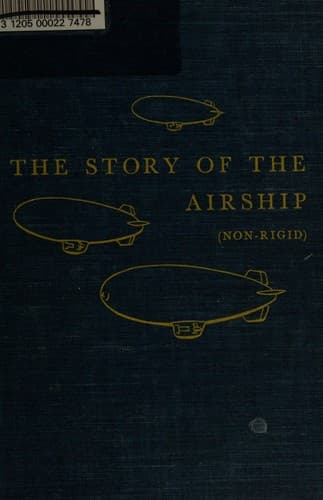
The Story of the Airship (Non-rigid): A Study of One of America's Lesser Known Defense WeaponsAllen, Hugh
History
The Story of the Airship (Non-rigid): A Study of One of America's Lesser Known Defense Weapons
Allen, Hugh
Military airships -- United States
In the meantime, Lt. Boyd, originally assigned to TC-14, was up at dawn
only to learn of the change in plans. He was assigned to pilot the
smaller G-1 trainer to New London, keep a sharp look-out enroute for the
missing plane, then work with the destroyers on torpedo exercises. The
G-1 had no galley aboard and in the rush the matter of food for an
18-hour cruise was somehow overlooked, and Boyd and his crew set off
with only a couple of sardine sandwiches apiece and a pot of coffee,
which quickly grew cold.
Late in the afternoon, seeing his crew growing hungrier and
hungrier,—for airshipping is excellent for the appetite,—Boyd had an
idea. He radioed the Destroyer Division Commander: “After last torpedo
recovered, would you be able to furnish us with some hot coffee and a
loaf of bread, if we lower a container on a 200-foot line across your
after deck?”
Never in naval history had an airship borrowed chow from a surface
craft. But the answer came promptly. “Affirmative. Do you wish cream and
sugar?”
There was nothing in the books giving the procedure for borrowing a meal
from the air, but the crew rigged up a line from a target sleeve reel,
fastened a hook with a quick release at the end, attached a monkey
wrench to weight it down, stood by for the word to come alongside.
Then while the crews of three destroyers watched, the G-1 swung slowly
over the destroyer’s deck. One sailor caught the line held it while a
second filled the coffee pot, and a third attached a load of sandwiches.
Then the airship sailors hauled away, radioed their thanks, set off for
the 200 mile trip back to Lakehurst, while hundreds of sailors below
waved their white caps and cheered, a little inter-ship courtesy between
sky and sea which all hands will long remember.
CHAPTER IV
The Beginnings of Flight
[Illustration: Hot-air balloon]
In the spring of 1783, as the American Revolution was nearing a
successful conclusion, two brothers named Montgolfier sitting before a
fire at a little town in France found themselves wondering why smoke
went up into the air.
That was just as foolish as Newton wondering why an apple, detached from
the tree, fell down. Smoke had always gone up and apples had always come
down. That was all there was to it.
But when men wonder momentous events may be in the making. In these
instances epochal discoveries resulted: the law of gravitation and the
possibility of human flight.
The legends of Icarus and the narrative of Darius Green are symbols of
the long ambition of earth-bound men, even before the days of recorded
history, to leave the earth and soar into the air. The Montgolfiers had
found the key.
But a hundred years would pass before the discovery would be put to use.
It was in 1903 that another pair of brothers, the Wrights, made their
first flight from Kill Devil Hill in North Carolina. The first Zeppelin
took off from the shores of Lake Constance in 1900.
Public-domain text, read in full here on John Shaqi.
Reviews
Reviews
No reviews yet
Be the first to share your thoughts on this work.
Join the Discussion
Join the discussion
Sign in to leave a comment or review.
Sign InorCreate an account