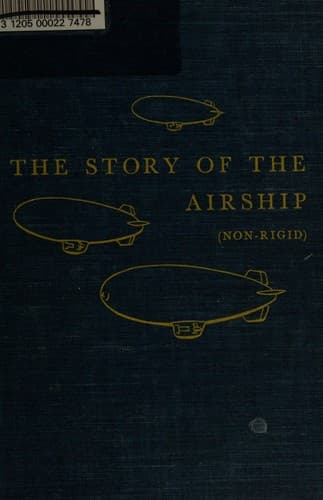
The Story of the Airship (Non-rigid): A Study of One of America's Lesser Known Defense WeaponsAllen, Hugh
History
The Story of the Airship (Non-rigid): A Study of One of America's Lesser Known Defense Weapons
Allen, Hugh
Military airships -- United States
High admirals of the American fleet faced in 1940 the gravest
responsibility in the National Defense the Navy had ever known. Wherever
they turned, north, east, south, west, perils lurked. If they swung
their binoculars toward Iceland, toward the Caribbean, toward Singapore,
Alaska, or the Canal, everywhere waited potential threats against our
American way of life, which they must meet with ships and men, with guns
and stout hearts. This was not merely national defense, perhaps not even
hemisphere defense, it was World War.
Surveying their gigantic task, and moving swiftly to meet it, they found
a place in their program for half forgotten craft, long over-shadowed by
other arms of the fleet, the non-rigid airship, sometimes called a
dirigible, but more often a “blimp.”
Couldn’t the airship be used as a watchdog along the coast, against
enemy submarines, in discovering enemy mines—relieve for sterner tasks
the destroyers and other craft now wallowing their innards out in those
restless shallow waters? Great Britain and France had used airships
effectively in this service over the English Channel during the last
war.
The areas within their patrol range, a hundred or 200 miles out to sea,
within the 100 fathom curve, was a vital one. There steamship lanes
converge, great harbors lie, coastwise merchantmen cruise, there is the
greatest concentration of military and commercial shipping.
With depth bombs and machine guns the blimps might strike a stout blow
of their own, even if they weren’t rated as combat craft. At least they
could sound the alarm, call out reinforcements from swift moving
shore-based craft, keep the intruder under surveillance. After all the
main thing was to find the submarines in those endless miles of water.
And in this field the very slowness of the airship, as compared to the
airplane, would be an advantage, permit a more thorough search of the
ocean’s surface, while its speed as compared to any man-of-war, would
enable it to cover more ground within a given 24 hours.
So on the Navy’s recommendation Congress in 1940 approved the building
of the airship fleet up to substantial proportions, together with bases
from which they might operate along the Atlantic and Pacific coasts.
That program is now being put into effect and the Goodyear company which
had built most of the airships used in the first World War, began again
to build ships.
The story of the great rigid airships, the Los Angeles, the Akron, Macon
and Graf Zeppelin is fairly well known. That of the smaller non-rigids
is less familiar. The larger airships still hold vital commercial and
military promise for the future. However, this book will confine itself
to the non-rigid airship, with only enough reference to the larger ships
to round out the picture.
Public-domain text, read in full here on John Shaqi.
Reviews
Reviews
No reviews yet
Be the first to share your thoughts on this work.
Join the Discussion
Join the discussion
Sign in to leave a comment or review.
Sign InorCreate an account