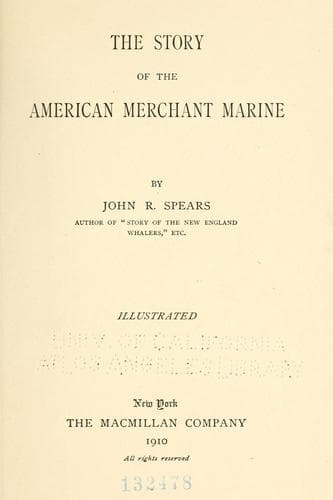
The Story of the American Merchant MarineSpears, John Randolph
History
The Story of the American Merchant Marine
Spears, John Randolph
Merchant marine -- United States
"We recollect that thirty years ago, when the _Manhattan_ was
launched--she was about 600 tons burden--all New York crowded down to see
her. She was the wonder of the day; and it was then believed that she was
the _ne plus ultra_ in ship building; that she was not only the largest
and finest ever built, but that ever could be built. From that day to
this they have gone on improving and building until they have now got to a
point of perfection that one would hardly suppose could be excelled. Our
ships, and particularly our packets, are admired by all nations wherever
they go; and although we do not admit that we cannot, by our skill,
ingenuity and capital, go on improving, the world admits that America is
without a rival in the noble art of building this description of vessel.
"We have, from time to time, given descriptions of the various ships that
have been put afloat.... We have now another to add--the ship _Roscius_,
built by E. K. Collins, belonging to the Dramatic Line, and to be
commanded by Captain John Collins. She is the largest that has yet been
built, and for strength and beauty is a noble specimen of American ship
building. The following are her dimensions:--
"Burden, 1100 tons; length of main deck, 170 feet; length of spar deck,
180 feet; breadth of beam, 36½ feet; depth of hold, 22 feet; height of
cabin, 6½ feet; height from keelson to main truck, 187 feet; length of
main yard, 75 feet."
Of the velvet used upon the sofas, and the Wilton carpets, the "scarlet
marino" drapery, "with white curtains," nothing more need be said, but
the facts that she cost $100,000 ($90 per ton) and would "stow about 3200
bales of cotton" are, perhaps, memorable.
With a little imagination a picture that warms the blood is found in
the following brief paragraph from a Liverpool paper published in July,
1836:--
"_Ship Race._--Twelve ships sailed from New York for Liverpool on the 8th
instant. Among them were the packet ships Sheffield, Allen; the Columbus,
Palmer; and the George Washington, H. Holdredge, and several first-rate
vessels, the Star, the Congress, the Josephine, &c. Heavy bets were
laid on the respective ships at the time of sailing. The three packet
ships having parted company, fell in with each other on the Banks of
Newfoundland. Here they parted. The George Washington passed Holyhead on
Saturday forenoon; two or three hours afterwards the Sheffield passed the
same place. Both ships entered the Mersey in the course of the afternoon,
after a run of seventeen days from port to port. The Columbus arrived
yesterday morning. None of the other ships have yet appeared."
Fancy a newspaper giving no more space than that to such a magnificent
race! Still, races of the kind were common in those days, and the sailor
can imagine how the ships were handled. The Palmer who commanded the
Columbus, by the way, was Nathaniel Brown Palmer, who discovered the
Antarctic Continent while in command of the _Hero_--"a little rising forty
tons."
Public-domain text, read in full here on John Shaqi.
Reviews
Reviews
No reviews yet
Be the first to share your thoughts on this work.
Elsewhere in the archive
Join the Discussion
Join the discussion
Sign in to leave a comment or review.
Sign InorCreate an account