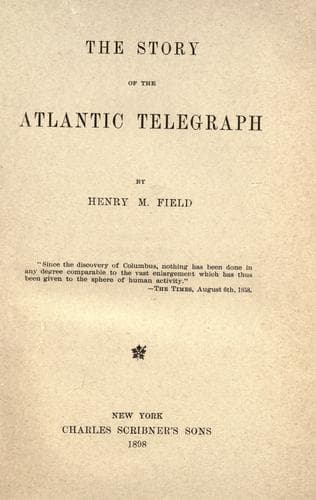
The Story of the Atlantic TelegraphField, Henry M. (Henry Martyn)
History
The Story of the Atlantic Telegraph
Field, Henry M. (Henry Martyn)
Transatlantic cables
"Throughout the greater portion of Monday morning the
electrical signals from the Niagara had been getting gradually
weaker, until they ceased altogether for nearly three-quarters
of an hour. Our uneasiness, however, was in some degree
lessened by the fact that the stoppage appeared to be a want of
continuity,[B] and not any defect in insulation, and there was
consequently every reason to suppose that it might arise from
faulty connection on board the Niagara. Accordingly Professor
Thomson sent a message to the effect that the signals were too
weak to be read, and, as if they had been awaiting such a
signal to increase their battery power, the deflections
immediately returned even stronger than they had ever been
before. Toward the evening, however, they again declined in
force for a short time. With the exception of these little
stoppages, the electrical condition of the submerged wire
seemed to be much improved. It was evident that the low
temperature of the water at the immense depth improved
considerably the insulating properties of the gutta-percha,
while the enormous pressure to which it must have been
subjected probably tended to consolidate its texture, and to
fill up any air-bubbles or slight faults in manufacture which
may have existed.
"The weather during Monday night moderated a little, but still
there was a very heavy sea on, which endangered the wire every
second minute.
"About three o'clock on Tuesday morning, all on board were
startled from their beds by the loud booming of a gun. Every
one, without waiting for the performance of the most particular
toilet, rushed on deck to ascertain the cause of the
disturbance. Contrary to all expectation, the cable was safe,
but just in the gray light could be seen the Valorous rounded
to in the most warlike attitude, firing gun after gun in quick
succession toward a large American bark, which, quite
unconscious of our proceeding, was standing right across our
stern. Such loud and repeated remonstrances from a large steam
frigate were not to be despised, and, evidently without knowing
the why or the wherefore, she quickly threw her sails aback and
remained hove to. Whether those on board her considered that we
were engaged in some filibustering expedition, or regarded our
proceedings as another British outrage upon the American flag,
it is impossible to say; but certain it is that, apparently in
great trepidation, she remained hove to until we had lost sight
of her in the distance.
Public-domain text, read in full here on John Shaqi.
Reviews
Reviews
No reviews yet
Be the first to share your thoughts on this work.
Elsewhere in the archive
Join the Discussion
Join the discussion
Sign in to leave a comment or review.
Sign InorCreate an account