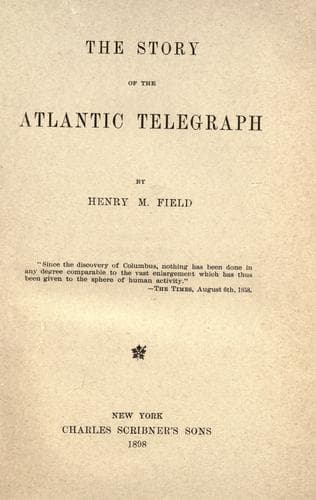
The Story of the Atlantic TelegraphField, Henry M. (Henry Martyn)
History
The Story of the Atlantic Telegraph
Field, Henry M. (Henry Martyn)
Transatlantic cables
"Tuesday was a much finer day than any we had experienced for
nearly a week, but still there was a considerable sea running,
and our dangers were far from passed; yet the hopes of our
ultimate success ran high. We had accomplished nearly the whole
of the deep-sea portion of the route in safety, and that, too,
under the most unfavorable circumstances possible; therefore
there was every reason to believe that unless some unforeseen
accident should occur, we should accomplish the remainder.
"About five o'clock in the evening, the steep submarine
mountain which divides the telegraphic plateau from the Irish
coast was reached, and the sudden shallowing of the water had a
very marked effect upon the cable, causing the strain on and
the speed of it to lessen every minute. A great deal of slack
was paid out to allow for any great inequalities which might
exist, though undiscovered by the sounding-line. About ten
o'clock the shoal water of two hundred and fifty fathoms was
reached; the only remaining anxiety now was the changing from
the lower main coil to that upon the upper deck, and this most
difficult and dangerous operation was successfully performed
between three and four o'clock on Wednesday morning.
"Wednesday was a beautiful, calm day; indeed, it was the first
on which any one would have thought of making a splice since
the day we started from the rendezvous. We therefore
congratulated ourselves on having saved a week by commencing
operations on the Thursday previous. At noon, we were
eighty-nine miles distant from the telegraph station at
Valentia. The water was shallow, so that there was no
difficulty in paying out the wire almost without any loss of
slack, and all looked upon the undertaking as virtually
accomplished.
"At about one o'clock in the evening, the second change from
the upper-deck coil to that upon the orlop-deck was safely
effected, and shortly after the vessels exchanged signals that
they were in two hundred fathoms water. As the night advanced
the speed of the ship was reduced, as it was known that we were
only a short distance from the land, and there would be no
advantage in making it before daylight in the morning. About
twelve o'clock, however, the Skelligs Light was seen in the
distance, and the Valorous steamed on ahead to lead us in to
the coast, firing rockets at intervals to direct us, which were
answered by us from the Agamemnon, though, according to Mr.
Moriarty, the master's wish, the ship, disregarding the
Valorous, kept her own course, which proved to be the right one
in the end.
Public-domain text, read in full here on John Shaqi.
Reviews
Reviews
No reviews yet
Be the first to share your thoughts on this work.
Elsewhere in the archive
Join the Discussion
Join the discussion
Sign in to leave a comment or review.
Sign InorCreate an account