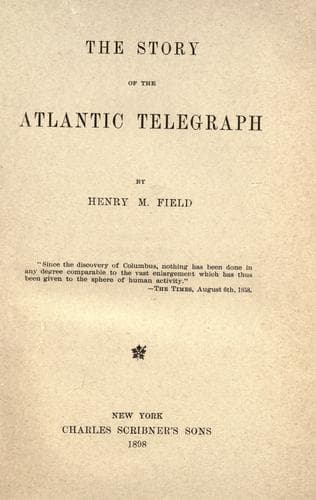
The Story of the Atlantic TelegraphField, Henry M. (Henry Martyn)
History
The Story of the Atlantic Telegraph
Field, Henry M. (Henry Martyn)
Transatlantic cables
The next morning after this illumination, the Niagara entered the harbor
of New York, and Mr. Field hastened to his home. The night before
leaving the ship, he had written to the Directors in London, giving a
full report of the laying of the cable, which he closed by resigning the
position which he had held for the last seven months. He wrote:
"At your unanimous request, but at a very great personal
sacrifice to myself, I accepted the office of General Manager
of the Atlantic Telegraph Company, for the sole purpose of
doing all in my power to aid you to make the enterprise
successful; and as that object has been attained, you will
please accept my resignation. It will always afford me pleasure
to do any thing in my power, consistent with my duties to my
family and my own private affairs, to promote the interests of
the Atlantic Telegraph Company."
Once more with his family, Mr. Field hoped for a brief interval of rest
and quiet. But this was impossible. The great event with which his name
was connected was too fresh in the public mind. He could not escape
public observation. He was at once thronged with visitors, offering
their congratulations, and his house surrounded with crowds eager to see
and hear him. While making all allowance for popular excitement, yet
none could deny that a service so great demanded some public
recognition. Even in England, where the enthusiasm did not approach that
in this country, still the wondrous character of the achievement was
fully acknowledged. Said the London Times on the morning of the sixth of
August: "Since the discovery of Columbus, nothing has been done in any
degree comparable to the vast enlargement which has thus been given to
the sphere of human activity." "More was done yesterday for the
consolidation of our empire, than the wisdom of our statesmen, the
liberality of our Legislature, or the loyalty of our colonists, could
ever have effected." To mark the public benefit which had been
conferred, the Chief Engineer of the Expedition, Mr. Charles T. Bright,
was knighted, and Captains Preedy and Aldham were both made Companions
of the Bath, and other officers were promoted. Thus England showed her
appreciation of their services.
But in this country titles and honors come not from the Government, but
from the people. Popular enthusiasm exhausted itself in eulogies of the
man who had linked the Old World to the New. It seems strange now to sit
down in cold blood and read what was published in the papers of that
day. A collection of American journals issued during that eventful
month, August, 1858, would be a literary curiosity.[A]
Public-domain text, read in full here on John Shaqi.
Reviews
Reviews
No reviews yet
Be the first to share your thoughts on this work.
Elsewhere in the archive
Join the Discussion
Join the discussion
Sign in to leave a comment or review.
Sign InorCreate an account