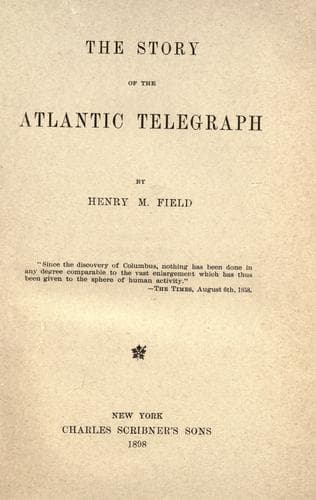
The Story of the Atlantic TelegraphField, Henry M. (Henry Martyn)
History
The Story of the Atlantic Telegraph
Field, Henry M. (Henry Martyn)
Transatlantic cables
Nor was it merely in such outward demonstrations that the public
enthusiasm showed itself. The feeling struck deeper, and reached all
minds. While the people shouted and cannon roared, sober and thoughtful
men pondered on the change that was being wrought in the earth. Business
men reasoned how it would affect the commerce of the world, while the
philanthropic regarded it as the forerunner of an age of universal
peace. The first message flashed across the sea--even before that of the
Queen--had been one of religious exultation. It was from the Directors
in Great Britain to those on this side the Atlantic, and, simply
reciting the fact that Europe and America were united by telegraph, at
once broke into a strain of religious rapture, echoing the song of the
angels over a Saviour's birth: "Glory to God in the highest; on earth,
peace, good-will toward men." Poetry at once caught up the strain. The
event became the theme of innumerable odes and hymns, of which it must
be said that, whatever their merit as poetry, their spirit at least was
noble, celebrating the event chiefly as promoting the brotherhood of the
human family. The key-note was struck in such lines as these:
'Tis done! the angry sea consents,
The nations stand no more apart,
With claspèd hands the continents
Feel throbbings of each other's heart.
Speed, speed the cable; let it run
A loving girdle round the earth,
Till all the nations 'neath the sun
Shall be as brothers of one hearth;
As brothers pledging, hand in hand,
One freedom for the world abroad,
One commerce over every land,
One language and one God.
Public-domain text, read in full here on John Shaqi.
Reviews
Reviews
No reviews yet
Be the first to share your thoughts on this work.
Elsewhere in the archive
Join the Discussion
Join the discussion
Sign in to leave a comment or review.
Sign InorCreate an account