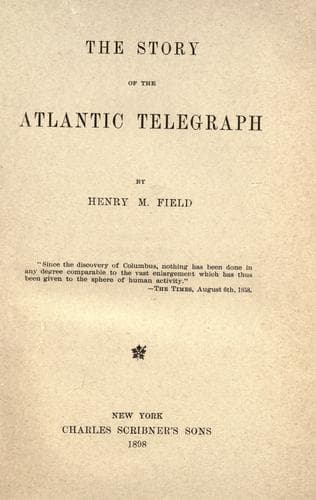
The Story of the Atlantic TelegraphField, Henry M. (Henry Martyn)
History
The Story of the Atlantic Telegraph
Field, Henry M. (Henry Martyn)
Transatlantic cables
1st. To begin with, the cable was not constructed in the most perfect
manner. Its makers, though the best then in the world, had had but
little experience in making deep-sea cables. No line over three hundred
miles long had ever been laid. 2d. It had been made more than a year
before. After it was finished, part of it had been coiled out of doors,
where it was exposed to a burning sun, by which, as was afterward found,
the gutta-percha had been melted in many places till the insulation was
nearly destroyed. 3d. It had been put on board the ships in 1857, and
after the first failure, had been taken out and coiled on the dock at
Plymouth, and then re-shipped in 1858. Thus it had been twisted and
untwisted, some portions of it as many as ten times. Then the Agamemnon
was so shaken in the terrible gale of June, that the cable on board of
her was seriously injured, and some portions were cut out and condemned.
Taking all these things together, the wonder is, not that the cable
failed after a month, but that it ever worked at all!
Owing to this impaired state of the cable, it did _not_ work perfectly.
Probably it would not have worked at all with ordinary instruments. But
the galvanometer of Professor Thomson, that instrument of marvellous
delicacy, drew faint whispers from its muttering lips. Signals came and
went, which showed that the electric current passed from shore to shore,
and gave promise that with delicate handling it could be taught to speak
plainly. But for the present it spoke slowly and with difficulty. It
often took hours to get through a single despatch of any length. Witness
the delay in transmitting the Queen's message! These frequent
interruptions were ascribed to various causes. Sometimes it was
earth-currents; at others, a thunderstorm was raging. Thus, on the
morning of Thursday, the twenty-sixth of August, there was a violent
storm in Newfoundland, heavy rain, accompanied by thunder and lightning.
At three o'clock, the lightning was so intense that for an hour and a
half the end of the cable had to be put to the earth for protection.
After that the storm cleared away, and at seven o'clock the weather was
reported as very fine. But aside from these local and temporary causes,
the real difficulty was in the cable itself, whose insulation had been
fatally impaired, and which was now wearing out its life on the rocks of
the sea. These causes made its speech difficult and broken. Yet
sometimes it flashed up with sudden power. In one case, a message was
sent from the office at Trinity Bay to Ireland and an answer received
back in two minutes! Such incidents excited the liveliest hopes that all
difficulties would be speedily overcome, and justified the messages
which were sent to the New York papers from day to day, that the
instruments were being adjusted, by which it was expected that the line
would soon be put in perfect working order, and be thrown open to the
public.
Public-domain text, read in full here on John Shaqi.
Reviews
Reviews
No reviews yet
Be the first to share your thoughts on this work.
Elsewhere in the archive
Join the Discussion
Join the discussion
Sign in to leave a comment or review.
Sign InorCreate an account