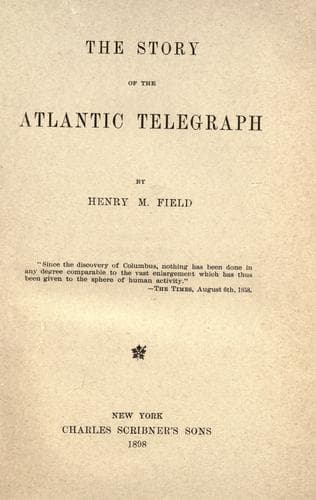
The Story of the Atlantic TelegraphField, Henry M. (Henry Martyn)
History
The Story of the Atlantic Telegraph
Field, Henry M. (Henry Martyn)
Transatlantic cables
But these flashes of light proved to be only the flickering of
the flame, that was soon to be extinguished in the eternal darkness of
the waters.
But the question which perplexed not only skeptics, but the truest
friends, was not whether the cable worked fast or slow, _but whether it
ever worked at all_. Happily, this is a question which can easily be
settled, since it is one simply of facts and dates, which can be
ascertained by referring to the files of the English and American
papers. Of course the only proof must be in messages containing _news_.
Mere congratulations between the Queen and the President, or the Mayor
of New York and the Mayor of London, prove nothing, for these might have
been prepared beforehand, if we suppose a design to impose on the
credulity of the public. But the decisive test is this: Was there at any
time within that month published in the English or American journals
_news_ which could not be matter of guess or conjecture, and within a
time too short for its possible transmission in any other way? If this
can be proved beyond all doubt, even in a few instances, the question is
decided, for the argument is just as strong with a dozen cases as with a
thousand. We give, therefore, a few dates, the accuracy of which can be
tested by any one who will take the trouble to examine the English and
American papers:
On Saturday, the fourteenth of August, the steamships Arabia and
Europa, the former bound for New York and the latter for Liverpool, came
into collision off Cape Race. The accident was not known in New York
until Tuesday, the seventeenth, since it could not be telegraphed till
the Arabia reached Halifax or the Europa St. John's, into which port she
put for repairs. As soon as the news reached New York, the agent of the
Company, Mr. Nimmo (Mr. Cunard himself being then in England), at once
prepared a despatch to be sent to relieve immediate anxiety. This was
not forwarded to Newfoundland, as peremptory orders had been given not
to transmit any private business messages to go through the cable until
the line was fully open to the public. But the next day Mr. Field
arrived in New York, and Mr. Nimmo applied to him. Seeing the urgency of
the case, he ordered it to be forwarded. It was accordingly sent, and
arrived in London on the twentieth, giving the first news that was
received of the accident. This was repeatedly stated by the late Sir
Samuel Cunard, of London, and confirmed by his son Mr. Edward Cunard, of
New York. The message was published in the London papers of the
twenty-first, as follows:
"Arabia in collision with Europa, Cape Race, Saturday. Arabia
on her way. Head slightly injured. Europa lost bowsprit,
cutwater stem sprung. Will remain in St. John's ten days from
sixteenth. Persia calls at St. John's for mails and passengers.
No loss of life or limb."
Public-domain text, read in full here on John Shaqi.
Reviews
Reviews
No reviews yet
Be the first to share your thoughts on this work.
Elsewhere in the archive
Join the Discussion
Join the discussion
Sign in to leave a comment or review.
Sign InorCreate an account