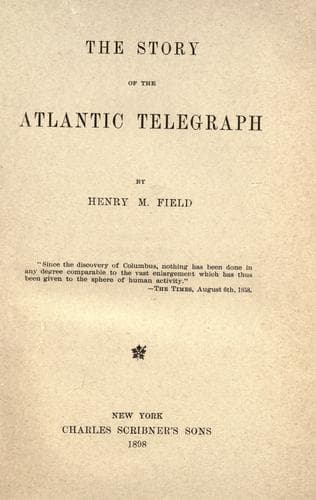
The Story of the Atlantic TelegraphField, Henry M. (Henry Martyn)
History
The Story of the Atlantic Telegraph
Field, Henry M. (Henry Martyn)
Transatlantic cables
for ages; that messages of friendship and love, from warm,
living bosoms, should burn over the cold, green bones of men
and women, whose hearts, once as warm as ours, burst as the
eternal gulfs closed and roared over them centuries ago!"
But a few years passed, and the vision became a reality. The heart of
the world beat under the sea.
FOOTNOTES:
[A] Captain Anderson, in a letter published after the return to England,
says: "Every officer and man of the expedition will have pleasant
recollection of the cheerful zeal of Captain Commerill, V.C., and the
officers of Her Majesty's ship Terrible. Captain Commerill frequently
visited us in his boats, both in high seas and in calms, and his cheery
way of saying, 'You'll do it yet,' 'What can I do?' and 'I'll do it,'
was truly characteristic of him. The officers of the Terrible would do
any thing for their captain, and entered heartily into the object of the
voyage."
Such a tribute from one brave commander to another, is most honorable to
both. In the same letter he recognizes, also, the services rendered by
the captains of the other ships: "I shall do but scant justice to
Commanders Prowse and Batt, R. N., and Captains Eddington and Harris,
Mercantile Marine, of the Medway and Albany, if I recall the three weeks
spent upon the 'grappling ground,' where we were often separated by fog,
gale, or darkness; yet whenever day dawned, or the fog cleared, there
the squadron were to be seen, converging from different points towards
the Mark Buoy, a small spot looking no bigger than a man's hat on the
surface of the ocean. Unless all had concentrated their minds, and
watched their ships and compasses night and day, no such beautiful
illustration of nautical science could have been possible. The vessels
of the squadron keeping always together, and commanded by men who knew
the importance of keeping close enough to begin work whenever it was
possible, and yet to avoid collision in fog, was of the greatest
importance; and we owe much to that invaluable system of signalling by
night and day, invented by Captain Colomb, R. N., which enabled us, even
in dark nights, when two or three miles apart, to communicate or
ascertain anything we desired."
[B] This is an error. Mr. Crocker, an operator in the Telegraph House at
Valentia, was the fortunate one on watch at that hour, on whose eye the
first ray fell, as a spark of life from the dead.
[C] Speech at the Chamber of Commerce Dinner, Nov. 15, 1866.
CHAPTER XVIII.
THE AFTERGLOW.
Public-domain text, read in full here on John Shaqi.
Reviews
Reviews
No reviews yet
Be the first to share your thoughts on this work.
Elsewhere in the archive
Join the Discussion
Join the discussion
Sign in to leave a comment or review.
Sign InorCreate an account