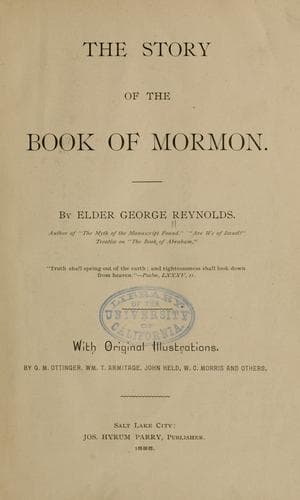
Book of Mormon; Latter Day Saint churches -- Doctrines; Latter Day Saints
It has been wisely said, It is very evident that pure words of either
the Hebrew or Egyptian tongue could hardly be expected in the Book
of Mormon, for the reason that the Nephites had altered the Hebrew,
and their language was so completely changed that their speech could
not be understood by other races. But although the structure of their
language had thus changed, it does not follow that all the words had
been replaced by others entirely unlike the former language spoken
and written by them. It is logical to expect many remnants of the
ancient roots, which, however much changed, may retain so much of their
original types as to be capable of identification. Thus, in the word
_Ziff_, which the Prophet Joseph tells us was a metal, we find a word
of the same sound as the Hebrew word ziph or seph, which means a metal.
The metal laid over statues was so called. It is true that the word
ziff is not spelled the same, but in its orthography is like the name
of the Hebrew month, Ziff. But the word ziff means brightness--metallic
brightness. (The word is used in Daniel ii., 31, also in Isaiah xxx.,
22, where it means overlaying metal.)
_Rameumptom_ was the name given by the Zoramite apostates to the
elevated place in their synagogues, from whence they offered up their
vain-glorious and hypocritical prayers. Alma states the word means a
holy stand. It resembles, in its roots, Hebrew, and also Egyptian, in a
remarkable manner. _Ramoth_, high (as Ramoth Gilead), elevated, a place
where one can see and be seen; or, in a figurative sense, sublime or
exalted. _Mptom_ has probably its root in the Hebrew word translated
_threshold_, as we are told that the Philistine god, Dagon, had a
threshold in Ashdod (see I. Samuel v., 4, 5). Words with this root
are quite numerous in the Bible. Thus we see how Rameumptom means an
exalted place to stand upon, a pulpit or holy stand.
_Sheum_, a kind of grain, is singularly like the Hebrew Shum (garlic),
as found in Numbers xi., 5.
_Gazelem_ appears to have its roots in Gaz--a stone, and Aleim, a name
of God as a revelator or interposer in the affairs of men. If this
suggestion be correct, its roots admirably agree with its apparent
meaning--a seer. The text reads: And the Lord said, I will prepare
unto my servant Gazelem, a stone, which shall shine forth in darkness
unto light, that I may discover unto my people who serve me, that I
may discover unto them the works of their brethren: yea, their secret
works, their works of darkness, and their wickedness and abominations.
Public-domain text, read in full here on John Shaqi.
Reviews
Reviews
No reviews yet
Be the first to share your thoughts on this work.
Elsewhere in the archive
Join the Discussion
Join the discussion
Sign in to leave a comment or review.
Sign InorCreate an account