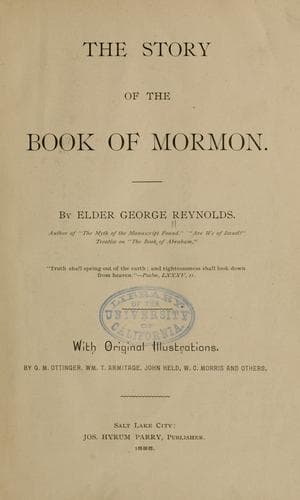
Book of Mormon; Latter Day Saint churches -- Doctrines; Latter Day Saints
_Rabbanah_ is another wonderful word. It is the title applied by
the servants of king Lamoni to Ammon, the son of Mosiah, after his
miraculous exploits at the waters of Sebus. It is translated powerful
or great king. Whether it was a Nephite or Lamanite word is uncertain,
as the Lamanites of that age (B. C. 91) had been taught by royal
command in the language of the Nephites. It is, however, of little
moment to which of these kindred tongues it belonged, but its Hebrew
derivation is most unmistakable. Its origin is evidently in _abba_,
father. Max Muller, the great modern authority on such points, says
the word king originally meant father; having doubtless taken this
form in the earliest patriarchal days when the king ruled by right of
his fatherhood, and represented God, the Great Father of us all. This
ancient American word confirms Professor Muller's statement; while
it manifests how remarkably the unities of the Book of Mormon are
preserved, consistent only with its claim to Divine inspiration. It
would be the height of folly to ascribe such a coincidence to chance;
a man must be far more credulous to so believe, than it can possibly
be claimed such are who place implicit confidence in the realities of
Nephite and Lamanite history.
From the few examples of words and names before us, we judge the
Lamanite language to have been quite musical. Such names as Rabbanah,
Lamoni, Lehonti, Middoni, Antionum, Onidah, etc., are certainly
specimens of a soft, flowing, pleasing form of speech.
One practice, that of word building, or adding several words together
to form a new word, which combination gave expression to the desired
idea, obviously obtained among the Lamanites. As examples we have
the city of Lehi-Nephi, the village of Ani-Anti and the people of
Anti-Nephi-Lehi. Such a practice is frequent among many families
of their modern representatives. It was found to exist among the
Mexicans--the Aztecs--by the early Spanish invaders, and today is
practiced by our near neighbors the Shoshones. This habit explains the
reasons for the existence of so many words of great length found in
both of these tongues.
FOOTNOTE:
[21] No claim has been advanced, we believe, which advocates an actual
Egyptian colonization of the New World, but strong arguments have been
used to show that the architecture and sculpture of Central America and
Mexico have been influenced from Egypt, if not attributable directly to
Egyptian artisans.--J. T. SHORT.
The hieroglyphics, symbols and emblems which have been discovered in
the temples bear so strong a resemblance to those of the Egyptians as
to encourage the supposition that a colony of that nation may have
founded the city of Palenque or Culhuacan.--JAURROS.
Public-domain text, read in full here on John Shaqi.
Reviews
Reviews
No reviews yet
Be the first to share your thoughts on this work.
Elsewhere in the archive
Join the Discussion
Join the discussion
Sign in to leave a comment or review.
Sign InorCreate an account