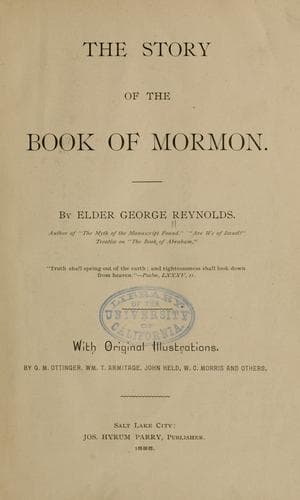
Book of Mormon; Latter Day Saint churches -- Doctrines; Latter Day Saints
Giordan found the most striking analogies between the Central American
and Mexican remains and those of the Egyptians. The idols and
monuments he considers of the same form in both countries, while the
hieroglyphics of Palenque do not differ from those of ancient Thebes.
CHAPTER LXIV.
NEPHITE PROPER NAMES--BIBLE
NAMES--SARIAH--NEPHI--SAM--MELEK--JERSHON--ISABEL--AHA,
ETC.,--PREFIXES AND SUFFIXES.
The number of Bible proper names found in the Book of Mormon has been
now and again urged as an argument against its divine origin. If those
making these objections were to calmly consider the matter, we believe
they would quickly acknowledge that it would be very inconsistent to
expect the opposite. Nearly all devout races are in the habit of naming
their children after the holy men--patriarchs, martyrs and sages--whose
lives they reverence, and whose virtues they desire to see reproduced
in their offspring. It is so with ourselves; nearly all our most
familiar names are English forms of Bible names. For example: John,
James, Jacob, Joseph and Thomas among men, and Mary, Anna, Elizabeth
and Sarah among women. So it was with the Nephites. The Hebrew was the
language of their sacred literature; while their fondest recollections,
their holiest pride ran back to the days of Joseph and Joshua, Samuel
and Isaiah, and, like other races, they named their children after the
ancient worthies they reverenced most. Hence, we find the following
Bible names borne by the descendants of Lehi[22] and Sariah: Aaron,
Aminadab, Ammon, Ammah, Amos, Benjamin, Enos, Gideon, Gilgal, Helam,
Helem, Isaiah, Ishmael, Jacob, Joseph, Jeremiah, Jonas, Laban, Lemuel,
Noah, Samuel, Shem, Timothy and Zedekiah. A few others are evidently
slightly altered Hebrew names, as Chemish from Chemosh, Sherem from
Shaaraim, and Zenos from Zenas. Indeed, there may be no actual
difference; the apparent change may arise from the English translators
inserting a wrong vowel sound in words where, according to the ancient
custom, the consonants only were written.
We will now consider a few proper names found in the Book of Mormon,
but not in the Bible; for, notwithstanding the changes made by the
Nephites in their language, the derivation and significance of many
of these names are evident, when considered in connection with the
languages of the races with whom the ancient Hebrews were brought most
closely in contact.
_Sariah_ is obviously Hebrew. It is a name of extreme beauty and force.
Its roots are in Sara, a princess, and Jah or Iah, Jehovah, thus
meaning a princess of Jehovah; a most fitting name for the mother of a
multitude of nations.
Public-domain text, read in full here on John Shaqi.
Reviews
Reviews
No reviews yet
Be the first to share your thoughts on this work.
Elsewhere in the archive
Join the Discussion
Join the discussion
Sign in to leave a comment or review.
Sign InorCreate an account