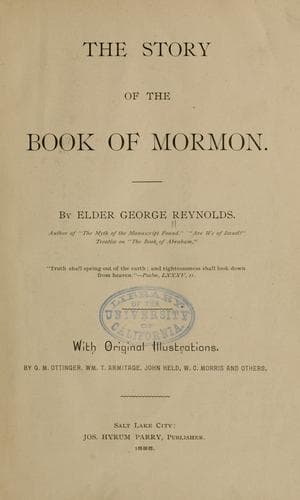
Book of Mormon; Latter Day Saint churches -- Doctrines; Latter Day Saints
Shortly before Jarom died he delivered the sacred plates to his son
Omni. Omni kept them for about forty-four years and then handed them
to his son Amaron; who in turn transferred them to his brother Chemish.
Chemish, when his end drew near, placed them in the hands of his son
Abinadom, who afterwards gave them in charge of his son Amaleki.
It is very little that we know of the history of the Nephites from the
death of Jarom to the time of Amaleki, a period of about one hundred
and fifty years. The political records of the nation were engraved on
other plates, which were kept by the kings, and as there was little
that the ecclesiastical historians felt it necessary to write beyond
what Nephi and Jacob had written, their records are very short. From
what little we can glean from these writings it is evident that during
this era the Nephites had frequent wars with the Lamanites, in many
of which they suffered severely. The Lord permitted these wild sons
of the wilderness to be a constant scourge to the people of Nephi
when they turned away from him; and we fear that the seasons were not
unfrequent when they had to be reminded of their duty in this terrible
way. It also seems probable that, to avoid the constant incursions of
the warriors of the house of Laman, the Nephites had more than once
forsaken their homes and retired farther northward into the wilderness.
We judge this from the fact that in the days of Amaleki, the land of
Nephi appears to have been in or near the region we call Ecuador, a
country far distant from the place where Lehi's colony first landed;
and it is scarcely consistent with the narrative of the Book of Mormon
to believe that Nephi and his little band, when they first separated
from their brethren, made a journey of so many hundreds of miles before
they established their homes. Then the very fact that the Lamanites
almost immediately began to harass them in the new land which they
occupied is strong evidence that their first removal was not so distant
but that these enemies could, without great difficulty, reach them, a
thing that would have been almost impossible if they had gone directly
to the far distant region of Ecuador.
We now come to the days of the first Mosiah. But before relating the
story of his life and reign we will briefly summarize what we know of
the history of the Nephites during the first four hundred years of
their national existence.
They were governed by kings who were the direct descendants of Nephi.
These kings were, as a rule, righteous men and wise rulers. The law of
Moses was strictly observed, and other good and just laws were enacted
to regulate those matters which the Mosaic laws did not touch.
The Nephites multiplied greatly, and also grew exceedingly rich in the
wealth of this world; while their artisans and mechanics were very
expert in the arts and manufactures. They also spread abroad on the
face of the land of Nephi and were much scattered.
Public-domain text, read in full here on John Shaqi.
Reviews
Reviews
No reviews yet
Be the first to share your thoughts on this work.
Join the Discussion
Join the discussion
Sign in to leave a comment or review.
Sign InorCreate an account