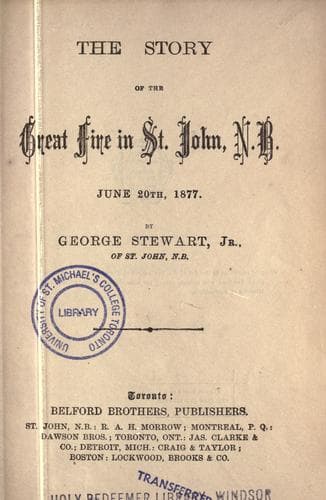
The Story of the Great Fire in St. John, N.B., June 20th, 1877 — John Shaqi
The Story of the Great Fire in St. John, N.B., June 20th, 1877Stewart, George
History
The Story of the Great Fire in St. John, N.B., June 20th, 1877
Stewart, George
Saint John (N.B.) -- Fire, 1877
The great fire, for we must distinguish it by that title, since in
vastness it overpowers all other similar calamities which have befallen
St. John, originated in the late Joseph Fairweather's building, York
Point, Portland, at half past two on Wednesday afternoon, 20th June. The
writer and Mr. Frederick R. Fairweather were walking down King Street at
the time of the alarm, and, in company with hundreds of others, visited
the scene of what promised at the time to be a very small affair indeed.
When the place was reached, McLaughlin's boiler shop was in flames and
all efforts of the firemen to put out the fire were checkmated at every
turn by the fierce north-west wind which was blowing a perfect gale. In
a few minutes the fire spread with alarming rapidity, and houses went
down as if a mine of powder had exploded and razed them. The wind lifted
from the roofs immense brands and sparks, and by three o'clock the city
was in flames at a dozen points. Lower Cove was on fire, and the dryness
of the houses rendered them as useless to withstand the blaze as bits of
paper would have been. The huge blazing brands were carried along in
the air for miles around, and where-ever they dropped a house went down.
The engines were powerless, and the firemen, though they worked like
heroes, availed but little. The wild, mad flames, now in sheets, now
with a million tongues of angry fork-like columns, dashed against the
wharves, levelling them to the water's edge, ripping up the pavements of
the streets, and crushing houses out of existence in a single swoop.
Nothing could be done. The leaping demon swept all before him. Hare's
Wharf with its buildings bowed before the destroyer, and with a roar
which thrilled every heart, and unnerved every man who stood there, the
whole force of the fire dashed into Smyth Street and shattered every
building in it. J. W. Nicholson's wine vaults, Harrison's flour
warehouse, Logan & Lindsay's storehouse, Robertson Place, which exceeded
in value half a million of dollars, were snapped up in a second. The
flames spread into Drury Lane and Mill Street, and soon both sides of
Dock Street were in the common ruin. But while this was going on, the
rear of the London House, in Market Square, was threatened and the old
barracks in Lower Cove were on fire. A reinforcement from Carleton and
Portland fire departments came to the assistance of the firemen at this
juncture, and every man worked with a will. The hose was directed with
admirable expertness but the high wind baffled the efforts of all who
stood before it. It could rise higher than the water, and it could
travel faster than man. A mass of flames at the end of Smyth Street and
Drury Lane burned close to an engine, but the dauntless firemen,
holding boards over their heads to protect their faces and eyes from the
heat, gave battle to the relentless foe. It was a fight of water and
human endurance against fire, and fire prevailed in the end. The unequal
Public-domain text, read in full here on John Shaqi.
Reviews
Reviews
No reviews yet
Be the first to share your thoughts on this work.
Join the Discussion
Join the discussion
Sign in to leave a comment or review.
Sign InorCreate an account