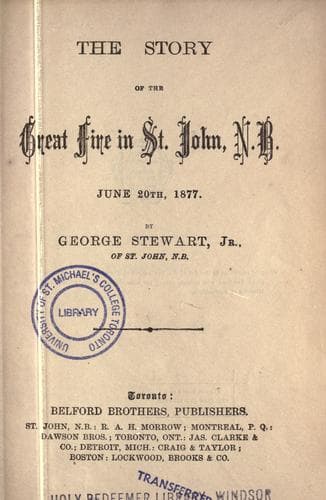
The Story of the Great Fire in St. John, N.B., June 20th, 1877Stewart, George
History
The Story of the Great Fire in St. John, N.B., June 20th, 1877
Stewart, George
Saint John (N.B.) -- Fire, 1877
Manchester, Robertson & Allison, may be said to have begun business.
They left here, W. W. Jordan taking the store, to occupy their
commodious premises in King Street, which alone kept off the fire
from the north side of King Street. The saving of this building was one
of the marvels of the present calamity. It really held the key to the
whole of this side of the street. But for the laundry and the well
managed protective means employed by the firm and their friends, the
destruction of this house and the entire street would have been
accomplished. Men stood idly in the courtway folding their arms and
telling one another that the building could not possibly be saved, when
Mr. Manchester, in his short impulsive way, told them if every one did
as they were doing, it could not; but he intended to use every effort in
his power before he gave it up. The firemen here worked with a will, and
were rewarded with a splendid result. It was on this side of the street
that the Western Union Telegraph Office was situated, and it and Mr. J.
W. Hall's new building were the first to go. The Maritime Block--a
splendid structure--in which the banks, Maritime, Montreal and Nova
Scotia, were established, and which faced the Market Square, went down
while it was yet daylight. In this building the offices of the school
trustees, Dun, Wiman & Co., A. P. Rolph, Lumber Exchange, and Board of
Trade were held. While Mr. Rolph was engaged in getting his things ready
to move out, Mr. Richard Thompson's men were hastening in with
silver-ware and jewelry, thinking in their excitement that this building
was at all events safe. Mr. Thompson's loss is very heavy, and the
damage to his elegant and costly stock is considerable. The lot on which
the Sheffield House stood was offered some years ago, at private sale,
to John Wilmot, Esq., father of Senator R. Duncan Wilmot, by James
Brimner, for £2,000. Mr. Wilmot refused it, and attended the auction
sale when it was knocked down to him for £2,950. The police office went
next, Watts & Turner's, H. & H. McCullough's, and round again to the
north wharf, carrying Lewin & Allingham, Chas. R. Ray, W. H. Thorne &
Co. (retail), and Thomas M. Reed, along with it. The destruction on the
north wharf totally demolished the establishment of Jas. Domville & Co.,
and the books of the firm which had been taken to the Maritime Bank for
safe keeping, were subsequently burned there. The saving of the Bank of
British North America, the only monetary institution in the city which
resumed business the next day as usual, was one of those wonderful
events which only occur at rare intervals. The fire roared lustily in
the rear of the bank, but something seemed to command it to halt there,
and advance no further. A large barn went down, and now it was deemed
certain that the bank would go next, but no, the fire crossed the
square, dashed along Water Street, cut into Ward Street, destroyed a
Public-domain text, read in full here on John Shaqi.
Reviews
Reviews
No reviews yet
Be the first to share your thoughts on this work.
Join the Discussion
Join the discussion
Sign in to leave a comment or review.
Sign InorCreate an account