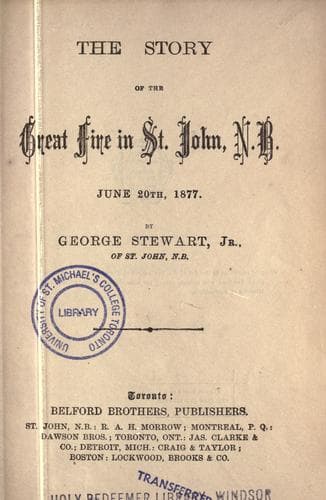
The Story of the Great Fire in St. John, N.B., June 20th, 1877 — John Shaqi
The Story of the Great Fire in St. John, N.B., June 20th, 1877Stewart, George
History
The Story of the Great Fire in St. John, N.B., June 20th, 1877
Stewart, George
Saint John (N.B.) -- Fire, 1877
The fourth rector was the Rev. Dr. Robert Willis--a Navy chaplain and a
very eminent man. His ship was at Halifax coaling, when intelligence
reached him that Mr. Pidgeon was seriously ill, and that the church in
St. John was closed in consequence. He left at once for St. John where
he officiated for several weeks, and on the death of Mr. Pidgeon was
chosen rector. The Stone Church and St. George's, Carleton, were erected
during his incumbency, and this caused a division in the Parish. Dr.
Willis became rector of St. Paul's, Halifax, in 1825, and Arch-Deacon of
Nova Scotia, which offices he held until the year 1865, when he died at
the age of 80. He was the father of Rev. Cuthbert Willis, rector of
Salisbury, who was formerly of the 15th regiment of foot.
In 1825 the Rev. Benjamin Gerrish Gray, D.D., succeeded Dr. Willis as
rector of St. John. He was born in Boston 1768, and on the departure of
the British troops from that city, while yet a child, he went with his
father to Halifax. He graduated at King's College, Windsor, completed
his education in England, and was ordained minister in 1796 by Bishop
Inglis at Halifax. Some years were spent by him as minister among the
Maroons, a discontented body of savages which the British Government
placed in Nova Scotia to the great annoyance and fear of the
inhabitants. The Doctor spent several years in connection with various
missions throughout Nova Scotia until 1819, when he became rector of St.
George's, Halifax. He laboured as rector in St. John on the death of Dr.
Willis, for fifteen years, when in 1840 he resigned his position. He
lived till 1854, when at the advanced age of 86 he died full of honours
and respect. He was a man of elevated tastes and liberal ideas. He loved
science, art and literature, and was a well informed and polished writer
and thinker. In 1833 one of the greatest calamities which ever befell
man happened to Dr. Gray. His house in Wellington Row took fire, and
before aid could come it was burned to the ground, together with the
rector's wife and a female domestic. No sympathy could alleviate the
suffering of the distracted husband, no words of man could take away the
agony of his deep grief and sorrow. It pressed heavily upon his mind,
and he was never again the same man. At this fire he lost his valuable
library which contained many rare and costly books and manuscripts,
together with the complete records of his parish.
Public-domain text, read in full here on John Shaqi.
Reviews
Reviews
No reviews yet
Be the first to share your thoughts on this work.
Join the Discussion
Join the discussion
Sign in to leave a comment or review.
Sign InorCreate an account