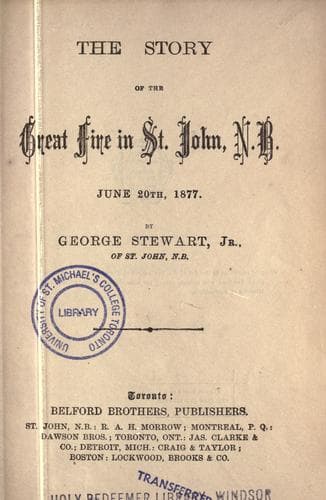
The Story of the Great Fire in St. John, N.B., June 20th, 1877Stewart, George
History
The Story of the Great Fire in St. John, N.B., June 20th, 1877
Stewart, George
Saint John (N.B.) -- Fire, 1877
It has been said of Scotchmen that next to love of country they revere
their religion. Indeed, the love is as warm for the one as it is for the
other. The Bible and Home. God and Scotland. Their religion has been
compared to their native Grampians, and some have said that it was as
hard, cold, determined and unyielding as those grand old hills
themselves, the very name of which sends a thrill through every
Scotchman's breast. Every Scottish poet has sung of home, every native
bard has written hymns and psalms. Burns's "Cotter's Saturday Night"
contains the germs of the Presbyterian faith, and Tannahill, Thomson,
Campbell, Hogg and all the other tuneful minstrels have sung in the same
key, and told of the old faith which the Covenanters felt on their
bleak hill-tops years ago, when it was deemed by some to be a crime to
worship God in more ways than one. It is as rare to find a Scotchman
unacquainted with the leading events in the Bible, the gist of the
shorter catechism, and the whole of the Psalms of David, including the
cxix, word for word, as it is difficult to enter a city all the world
over, and not find the sons of the old land filling the leading
positions in the place. Our readers may be sure that among the sturdy
loyalists not a few Presbyterians were to be found. When they reached
St. John, they settled in Lower Cove, and the first thing they did was
to consider the advisability of building a kirk. In 1784, the leading
men drew up a petition for a grant of land on which to lay the
foundation for a house of worship. It was sent to Governor Parr, and on
the 29th of June, of the same year, the grant was issued under the Great
Seal of Nova Scotia. John Boggs and others, for the Church of Scotland,
were the grantees. Their associates were Andrew Cornwall, James Reid,
John Menzie, Charles McPherson, William Henderson, John Gemmill, and
Robert Chillis, their heirs and assigns in trust. The document runs as
follows, and sets forth that the grant was, "for the erection, building
and accommodation of a meeting house or public place of worship for the
use of such of the inhabitants of the said town as now or shall
hereafter be of the Protestant profession of worship, approved of by the
General Assembly of the Church of Scotland * * * and further for the
erection and building and accommodation of a dwelling house, outhouse,
casements and conveniences for the habitation, use and occupation of a
minister to officiate and perform divine service in the meeting house
aforesaid, according to the form and professing aforesaid * * * and
further for the building and erection of a public school house and
public poor house, with proper accommodation and conveniences for the
use of the inhabitants of the said Township of Parr,[D] forever, and
upon this further trust and confidence to secure and defend the said
piece and tract of land, and all such buildings, edifices, and
improvements, commodities and appurtenances, to and for the several and
Public-domain text, read in full here on John Shaqi.
Reviews
Reviews
No reviews yet
Be the first to share your thoughts on this work.
Join the Discussion
Join the discussion
Sign in to leave a comment or review.
Sign InorCreate an account