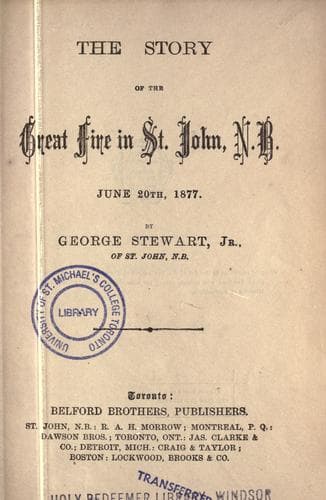
The Story of the Great Fire in St. John, N.B., June 20th, 1877Stewart, George
History
The Story of the Great Fire in St. John, N.B., June 20th, 1877
Stewart, George
Saint John (N.B.) -- Fire, 1877
Mr. Carey's Parsonage was on fire very soon after this, and all efforts
to save it or the old Baptist Church next door, proved unavailing. In a
short time only a blackened wall of smouldering ruins stood there to
tell in more eloquent language than words could relate, of the sad havoc
which the fire-king had made. For many years this church was to the
Baptists, what Trinity, St. Andrew's, and Germain Street Chapel were to
their denominations. It, too, had a history of its own, as dear to the
people who Sunday after Sunday sat within its walls and heard the word
of God spoken, as the historic data which filled every niche and corner
of the first English Church in the city. It was first built of wood
three score years ago, on the old site where the brick church stood, a
period ago since, and such men as John M. Wilmot, Thomas Pettingill, and
Jeremiah Drake, were the leading pillars and supporters of a body of
Christians distinguished alike for their charity, faithfulness, and
liberality. The church was organized in 1810, ground was broken in 1818
and the large frame building was opened for service July 12th of the
same year. Wm. Stenning and Thomas Harding purchased the site, and the
former gentleman superintended the building of the edifice. For many
years this was the only meeting-house which the Baptists had, and there
are men living to-day who remember the struggles and trials which the
denomination experienced in trying to plant a foothold in the sparsely
populated district which St. John then was. The pastors of this church
were known far and wide as earnest and faithful men, and such names as
Samuel Robinson, Casewell, Bill, Henry Vaughan, and G. M. W. Carey, live
in the hearts of all people and add lustre to any faith. When the
question of tearing down the old structure which had withstood the
storms of nearly half a century, and the replacing of it with a new one
to be built of brick was proposed, there were many in the congregation
who had grown up with the church through the long decades of time, and
who had watched the building step by step, advance to its completion,
and proudly take its place among the sacred edifices of the street of
churches. These men opposed the measure, but the march of new ideas
prevailed, and in 1863, the last of the old church was borne away and a
handsome brick building was begun. The former vestry was converted into
a parsonage, and the Rev. Henry Vaughan, son of the late Simon Vaughan,
of St. Martin's, was the minister in charge. The church cost forty
thousand dollars. Mr. Vaughan died in 1864. When Mr. Carey, the present
pastor, arrived in St. John in 1865, the church was being built and he
preached for a while in the basement, and in December, 1866, the first
sermon in the church proper was preached by the same eloquent minister.
A tablet was erected to the memory of his predecessor in the church. In
1873 this church was partially destroyed by fire, but the enterprising
Public-domain text, read in full here on John Shaqi.
Reviews
Reviews
No reviews yet
Be the first to share your thoughts on this work.
Join the Discussion
Join the discussion
Sign in to leave a comment or review.
Sign InorCreate an account