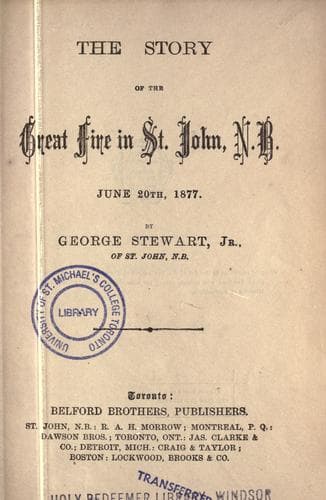
The Story of the Great Fire in St. John, N.B., June 20th, 1877Stewart, George
History
The Story of the Great Fire in St. John, N.B., June 20th, 1877
Stewart, George
Saint John (N.B.) -- Fire, 1877
John Armstrong who was succeeded by his son, Rev. Wm. Armstrong who
held the rectorship nearly twenty years. The building was of the
Gothic cruciform style of architecture and Mr. M. Stead was the
architect. It had no tower. The first wardens were the late John R.
Robinson, Esq., father of the agent in this city of the Bank of Nova
Scotia, and the late Wm. Wright. The church was situate on the south
side of Main Street, between Sydney and Carmarthen Streets and the lots
ran through to Sheffield Street. The Sunday-school building was built in
the rear.
The Sheffield Street Mission House and the Carmarthen Street Mission
House (Methodist) were structures of late origin, and for a while did
much good in the locality where they were placed. The fire visited them
very soon and they were burned in a short time. All along Carmarthen
Street the flames sped quickly, completely encircling every house with
which it came in contact, and whenever they met a crossing street the
fire drove through it with seeming greater fury and impetuosity. The
lately erected Adam's terrace--a row of comfortable dwellings just
finished within the year--burned with a tremendous roar that was heard
above the din, for blocks away. In these houses were the families of
Robt. Turner, Fred. R. Fairweather and W. C. Watson, Esqs., and so
quickly did the flames spread that hardly a stick of furniture was
saved, and hundreds of valuable books were burned. Judge Watters's
residence, the home of Attorney-General King, Henry A. Austin's, Madame
Caritte's, and the Henderson houses, hardly lived thirty minutes in the
winding sheets of flame. The fire came up Carmarthen Street, up
Princess Street, up Leinster Street, up Duke Street, up Orange Street,
to the rear of those streets and down King Street east and also in its
rear on a portion of the south side. Many believed and there seemed good
grounds for that belief, that but for the torch of the incendiary,
Leinster Street would have been preserved. No one doubts but that it was
set on fire by some miscreant either through madness or through the hope
of gain. This is beyond dispute. The fire was going in the opposite
direction, nothing could bring it up towards King Square and the head of
Leinster Street. It was out of all reason to suppose that the sparks
could be carried to these points for the wind was opposite, and the open
square had, till late in the evening, kept the flames away and broke the
connection. The old[J] Hazen House built by Dr. Thomas Paddock, which is
still standing to-day, and passed safely through the fire, stood
invincible at the head of a column of buildings. The fire was confined
to its own seething territory, and this block between Leinster and East
King Street, and the whole of King Square were safe. But as the night
advanced,[K] a house far away from the reach of flying cinders, was
observed on a sudden to be throwing out flames, and from that moment all
Public-domain text, read in full here on John Shaqi.
Reviews
Reviews
No reviews yet
Be the first to share your thoughts on this work.
Join the Discussion
Join the discussion
Sign in to leave a comment or review.
Sign InorCreate an account