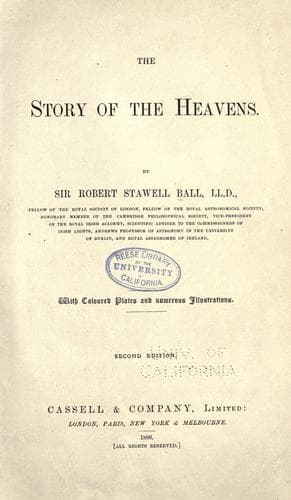
The Story of the HeavensBall, Robert S. (Robert Stawell)
History
The Story of the Heavens
Ball, Robert S. (Robert Stawell)
Astronomy
Admitting, then, the rectilinear path of the body, the next question
which arises relates to the velocity with which that movement is
performed. The stone gliding over the smooth ice on a frozen lake will,
as everyone has observed, travel a long distance before it comes to
rest. There is but little friction between the ice and the stone, but
still even on ice friction is not altogether absent; and as that
friction always tends to stop the motion, the stone will at length be
brought to rest. In a voyage through the solitudes of space, a body
experiences no friction; there is no tendency for the velocity to be
reduced, and consequently we believe that the body could journey on for
ever with unabated speed. No doubt such a statement seems at variance
with our ordinary experience. A sailing ship makes no progress on the
sea when the wind dies away. A train will gradually lose its velocity
when the steam has been turned off. A humming-top will slowly expend its
rotation and come to rest. From such instances it might be plausibly
argued that when the force has ceased to act, the motion that the force
generated gradually wanes, and ultimately vanishes. But in all these
cases it will be found, on reflection, that the decline of the motion is
to be attributed to the action of resisting forces. The sailing ship is
retarded by the rubbing of the water on its sides; the train is checked
by the friction of the wheels, and by the fact that it has to force its
way through the air; and the atmospheric resistance is mainly the cause
of the stopping of the humming-top, for if the air be withdrawn, by
making the experiment in a vacuum, the top will continue to spin for a
greatly lengthened period. We are thus led to admit that a body, once
projected freely in space and acted upon by no external resistance, will
continue to move on for ever in a straight line, and will preserve
unabated to the end of time the velocity with which it originally
started. This principle is known as the _first law of motion_.
Public-domain text, read in full here on John Shaqi.
Reviews
Reviews
No reviews yet
Be the first to share your thoughts on this work.
Elsewhere in the archive
Join the Discussion
Join the discussion
Sign in to leave a comment or review.
Sign InorCreate an account