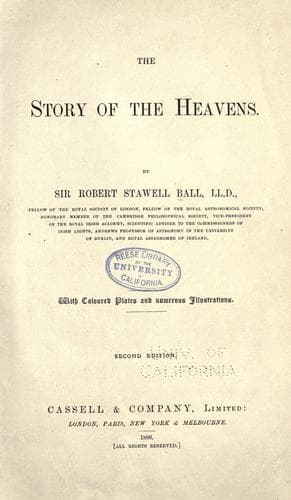
The Story of the HeavensBall, Robert S. (Robert Stawell)
History
The Story of the Heavens
Ball, Robert S. (Robert Stawell)
Astronomy
Let us apply this principle to the important question of the movement of
the planets. Take, for instance, the case of our earth, and let us
discuss the consequences of the first law of motion. We know that the
earth is moving each moment with a velocity of about eighteen miles a
second, and the first law of motion assures us that if this globe were
submitted to no external force, it would for ever pursue a straight
track through the universe, nor would it depart from the precise
velocity which it possesses at the present moment. But is the earth
moving in this manner? Obviously not. We have already found that our
globe is moving round the sun, and the comprehensive laws of Kepler have
given to that motion the most perfect distinctness and precision. The
consequence is irresistible. The earth cannot be free from external
force. Some potent influence on our globe must be in ceaseless action.
That influence, whatever it may be, constantly deflects the earth from
the rectilinear path which it tends to pursue, and constrains it to
trace out an ellipse instead of a straight line.
The great problem to be solved is now easily stated. There must be some
external agent constantly influencing the earth. What is that agent,
whence does it proceed, and to what laws is it submitted? Nor is the
question confined to the earth. Mercury and Venus, Mars, Jupiter, and
Saturn, unmistakably show that, as they are not moving in rectilinear
paths, they must be exposed to some force. What is this force which
guides the planets in their paths? Before the time of Newton this
question might have been asked in vain. It was the splendid genius of
Newton which supplied the answer, and thus revolutionised the whole of
modern science.
The data from which the question is to be answered must be obtained from
observation. We have here no problem which can be solved by mere
mathematical meditation. Mathematics is no doubt a useful, indeed, an
indispensable, instrument in the enquiry; but we must not attribute to
mathematics a potency which it does not possess. In a case of this kind,
all that mathematics can do is to interpret the results obtained by
observation. The data from which Newton proceeded were the observed
phenomena in the movement of the earth and the other planets. Those
facts had found a succinct expression by the aid of Kepler's laws. It
was, accordingly, the laws of Kepler which Newton took as the basis of
his labours, and it was for the interpretation of Kepler's laws that
Newton invoked the aid of that celebrated mathematical reasoning which
he created.
Public-domain text, read in full here on John Shaqi.
Reviews
Reviews
No reviews yet
Be the first to share your thoughts on this work.
Elsewhere in the archive
Join the Discussion
Join the discussion
Sign in to leave a comment or review.
Sign InorCreate an account