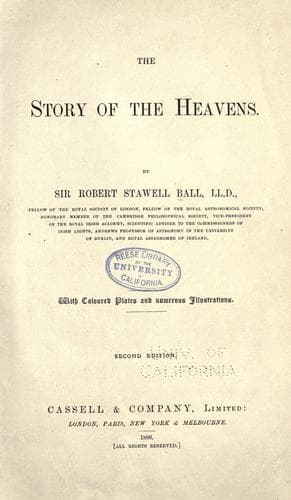
The Story of the HeavensBall, Robert S. (Robert Stawell)
History
The Story of the Heavens
Ball, Robert S. (Robert Stawell)
Astronomy
The pendulum thus enables us to make a gravitational survey of the
surface of the earth with the highest degree of accuracy. We cannot,
however, infer that gravity alone affects the oscillations of the
pendulum. We have seen how the earth rotates on its axis, and we have
attributed the bulging of the earth at the equator to this influence.
But the centrifugal force arising from the rotation has the effect of
decreasing the apparent weight of bodies, and the change is greatest at
the equator, and lessens gradually as we approach the poles. From this
cause alone the attraction of the pendulum at the equator is less than
elsewhere, and therefore the oscillations of the pendulum will take a
longer time there than at other localities. A part of the apparent
change in gravitation is accordingly due to the centrifugal force; but
there is, in addition, a real alteration.
In a work on astronomy it does not come within our scope to enter into
further detail on the subject of our planet. The surface of the earth,
its contour and its oceans, its mountain chains and its rivers, are for
the physical geographer; while its rocks and their contents, its
volcanoes and its earthquakes, are to be studied by the geologists and
the physicists.
CHAPTER X.
MARS.
Our nearer Neighbours in the Heavens--Surface of Mars can be
Examined in the Telescope--Remarkable Orbit of Mars--Resemblance of
Mars to a Star--Meaning of Opposition--The Eccentricity of the
Orbit of Mars--Different Oppositions of Mars--Apparent Movements of
the Planet--Effect of the Earth's Movement--Measurement of the
Distance of Mars--Theoretical Investigation of the Sun's
Distance--Drawings of the Planet--Is there Snow on Mars?--The
Rotation of the Planet--Gravitation on Mars--Has Mars any
Satellites?--Prof. Asaph Hall's great Discovery--The Revolutions of
the Satellites--Deimos and Phobos--"Gulliver's Travels."
The special relation in which we stand to one planet of our system has
necessitated a somewhat different treatment of that globe from the
treatment appropriate to the others. We discussed Mercury and Venus as
distant objects known chiefly by telescopic research, and by
calculations of which astronomical observations were the foundation. Our
knowledge of the earth is of a different character, and attained in a
different way. Yet it was necessary for symmetry that we should discuss
the earth after the planet Venus, in order to give to the earth its true
position in the solar system. But now that the earth has been passed in
our outward progress from the sun, we come to the planet Mars; and here
again we resume, though in a somewhat modified form, the methods that
were appropriate to Venus and to Mercury.
Public-domain text, read in full here on John Shaqi.
Reviews
Reviews
No reviews yet
Be the first to share your thoughts on this work.
Elsewhere in the archive
Join the Discussion
Join the discussion
Sign in to leave a comment or review.
Sign InorCreate an account