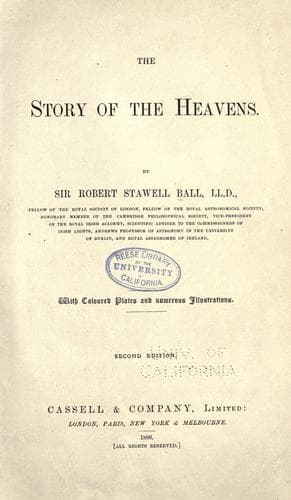
The Story of the HeavensBall, Robert S. (Robert Stawell)
History
The Story of the Heavens
Ball, Robert S. (Robert Stawell)
Astronomy
The duplication of the canals is perhaps the most difficult problem
which Mars offers to us for solution. Even if we admit that the canals
themselves represent inlets or channels through which the melted polar
snow makes its way across the equatorial continents, it is not easy to
see how the duplicate canals can arise. This is especially true in those
cases where the original channel seems to vanish and to be replaced by
two quite new canals, each about the breadth of the English Channel, and
lying one on each side of the course of the old one. The very obvious
explanation that the whole duplication is an optical illusion has been
brought forward more than once, but never in a conclusive manner. We
must, perhaps, be content to let the solution of this matter rest for
the present, in the hope that the extraordinary attention which this
planet is now receiving will in due time explain the present enigma.
The markings on the surface of this planet are, generally speaking, of a
permanent character, so that when we compare drawings made one or two
hundred years ago with drawings made more recently we can recognise in
each the same features. This permanence is, however, not nearly so
absolute as it is in the case of the moon. In addition to the canals
which we have already considered, many other parts of the surface of
Mars alter their outlines from time to time. This is particularly the
case with those dark spots which we call oceans, the contours of which
sometimes undergo modifications in matters of detail which are quite
unmistakable. Changes of colour are often observed on parts of the
planet, and though some of these observations may perhaps be attributed
to the influence of our own atmosphere on the planet's appearance, they
cannot be all thus accounted for. Some of the phenomena must certainly
be due to actual changes which have taken place on the surface of Mars.
As an example of such changes, we may refer to the north-western part of
the notable feature, to which Schiaparelli has given the name of _Syrtis
major_.[18] This has at various times been recorded as grey, green,
blue, brown, and even violet. When this region (about the time of the
autumnal equinox of the northern hemisphere) is situated in the middle
of the visible disc, the eastern part is distinctly greener than the
western. As the season progresses this characteristic colour gets
feebler, until the green tint is to be perceived only on the shores of
the Syrtis. The atmosphere of Mars is usually very transparent, and
fortunately allows us to scrutinise the surface of the planet without
putting obstacles in the way m the shape of Martian clouds. Such clouds,
however, are not invariably absent. Our view of the surface is
occasionally obstructed in such a manner as to make it certain that
clouds or mist in the atmosphere of Mars must be the cause of the
trouble.
Public-domain text, read in full here on John Shaqi.
Reviews
Reviews
No reviews yet
Be the first to share your thoughts on this work.
Elsewhere in the archive
Join the Discussion
Join the discussion
Sign in to leave a comment or review.
Sign InorCreate an account