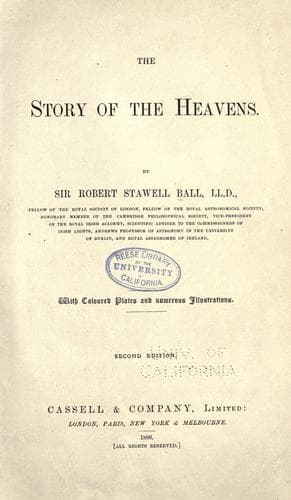
The Story of the HeavensBall, Robert S. (Robert Stawell)
History
The Story of the Heavens
Ball, Robert S. (Robert Stawell)
Astronomy
Would we form an idea of the physical constitution of the surface of
Mars, then the question as to the character of the atmosphere of the
planet is among the first to be considered. Spectroscopic observations
do not in this case render us much assistance. Of course, we know that
the planet has no intrinsic light. It merely shines by reflected
sunlight. The hemisphere which is turned towards the sun is bright, and
the hemisphere which is turned away from the sun is dark. The spectrum
ought, therefore, like that of the moon, to be an exact though faint
copy of the solar spectrum, unless the sun's rays, by passing twice
through the atmosphere of Mars, suffered some absorption which could
give rise to additional dark lines. Some of the earlier observers
thought that they could distinctly make out some such lines due, as was
supposed, to water vapour. The presence of such lines is, however,
denied by Mr. Campbell, of the Lick Observatory, and Professor Keeler,
at the Allegheny Observatory,[19] who, with their unrivalled
opportunities, both instrumental and climatic, could find no difference
between the spectra of Mars and the moon. If Mars had an atmosphere of
appreciable extent, its absorptive effect should be noticeable,
especially at the limb of the planet; but Mr. Campbell's observations do
not show any increased absorption at the limb. It would therefore seem
that Mars cannot have an extensive atmosphere, and this conclusion is
confirmed in several other ways.
The distinctness with which we see the surface of this planet tends to
show that the atmosphere must be very thin as compared with our own.
There can hardly be any doubt that an observer on Mars with a good
telescope would be unable to distinguish much of the features of the
earth's surface. This would be the case not only by reason of the strong
absorption of the light during the double passage through our
atmosphere, but also on account of the great diffusion of the light
caused by this same atmosphere. Also, it is needless to say, the great
amount of cloud generally floating over the earth would totally obscure
many parts of our planet from a Martian observer. But though, as already
mentioned, we occasionally find parts of Mars rendered indistinct, it
must be acknowledged that the clouds on Mars are very slight. We should
expect that the polar caps, if composed of snow, would, when melting,
produce clouds which would more or less hide the polar regions from our
inspection; yet nothing of the kind has ever been seen.
Public-domain text, read in full here on John Shaqi.
Reviews
Reviews
No reviews yet
Be the first to share your thoughts on this work.
Elsewhere in the archive
Join the Discussion
Join the discussion
Sign in to leave a comment or review.
Sign InorCreate an account