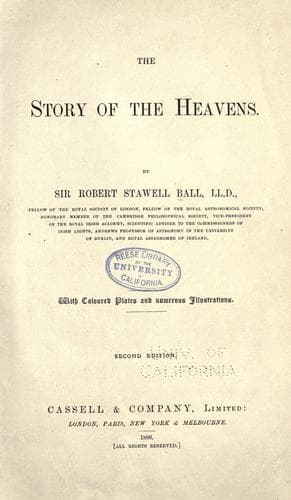
The Story of the HeavensBall, Robert S. (Robert Stawell)
History
The Story of the Heavens
Ball, Robert S. (Robert Stawell)
Astronomy
The true nature of these objects was at length discovered by Huyghens in
1655, nearly half a century after Galileo had first detected their
appearance. He perceived the shadow thrown by the ring upon the globe,
and his explanation of the phenomena was obtained in a very
philosophical manner. He noticed that the earth, the sun, and the moon
rotated upon their axes, and he therefore regarded it as a general law
that each one of the bodies in the system rotates about an axis. It is
true, observations had not yet been made which actually showed that
Saturn was also rotating; but it would be highly, nay, indeed,
infinitely, improbable that any planet should be devoid of such
movement. All the analogies of the system pointed to the conclusion that
the velocity of rotation would be considerable. One satellite of Saturn
was already known to revolve in a period of sixteen days, being little
more than half our month. Huyghens assumed--and it was a most reasonable
assumption--that Saturn in all probability rotated rapidly on its axis.
It was also to be observed that if these remarkable appendages were
attached by an actual bodily connection to the planet they must rotate
with Saturn. If, however, the appendages were not actually attached it
would still be necessary that they should rotate if the analogy of
Saturn to other objects in the system were to be in any degree
preserved. We see satellites near Jupiter which revolve around him. We
see, nearer home, how the moon revolves around the earth. We see how all
the planetary system revolves around the sun. All these considerations
were present to Huyghens when he came to the conclusion that, whether
the curious appendages were actually attached to the planet or were
physically free from it, they must still be in rotation.
Provided with such reasonings, it soon became easy to conjecture the
true nature of the Saturnian system. We have seen how the appendages
declined to invisibility once every fifteen years, and then gradually
reappeared in the form, at first, of rectilinear arms projecting
outwards from the planet. The progressive development is a slow one, and
for weeks and months, night after night, the same appearance is
presented with but little change. But all this time both Saturn and the
mysterious objects around him are rotating. Whatever these may be, they
present the same appearance to the eye, notwithstanding their ceaseless
motion of rotation.
Public-domain text, read in full here on John Shaqi.
Reviews
Reviews
No reviews yet
Be the first to share your thoughts on this work.
Elsewhere in the archive
Join the Discussion
Join the discussion
Sign in to leave a comment or review.
Sign InorCreate an account