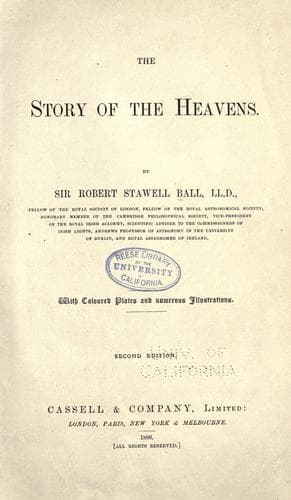
The Story of the HeavensBall, Robert S. (Robert Stawell)
History
The Story of the Heavens
Ball, Robert S. (Robert Stawell)
Astronomy
What must be the shape of an object which satisfies the conditions here
implied? It will obviously not suffice to regard the projections as two
spokes diverging from the planet. They would change from visibility to
invisibility in every rotation, and thus there would be ceaseless
alterations of the appearance instead of that slow and gradual change
which requires fifteen years for a complete period. There are, indeed,
other considerations which preclude the possibility of the objects being
anything of this character, for they are always of the same length as
compared with the diameter of the planet. A little reflection will show
that one supposition--and indeed only one--will meet all the facts of
the case. If there were a thin symmetrical ring rotating in its own
plane around the equator of Saturn, then the persistence of the object
from night to night would be accounted for. This at once removes the
greater part of the difficulty. For the rest, it was only necessary to
suppose that the ring was so thin that when turned actually edgewise to
the earth it became invisible, and then as the illuminated side of the
plane became turned more and more towards the earth the appendages to
the planet gradually increased. The handle-shaped appearance which the
object periodically assumed demonstrated that the ring could not be
attached to the globe.
At length Huyghens found that he had the clue to the great enigma which
had perplexed astronomers for the last fifty years. He saw that the ring
was an object of astonishing interest, unique at that time, as it is,
indeed, unique still. He felt, however, that he had hardly demonstrated
the matter with all the certainty which it merited, and which he thought
that by further attention he could secure. Yet he was loath to hazard
the loss of his discovery by an undue postponement of its announcement,
lest some other astronomer might intervene. How, then, was he to secure
his priority if the discovery should turn out correct, and at the same
time be enabled to perfect it at his leisure? He adopted the course,
usual at the time, of making his first announcement in cipher, and
accordingly, on March 5th, 1656, he published a tract, which contained
the following proposition:--
aaaaaaa ccccc d eeeee g h
iiiiiii llll mm nnnnnnnnn
oooo pp q rr s ttttt uuuuu
Public-domain text, read in full here on John Shaqi.
Reviews
Reviews
No reviews yet
Be the first to share your thoughts on this work.
Elsewhere in the archive
Join the Discussion
Join the discussion
Sign in to leave a comment or review.
Sign InorCreate an account