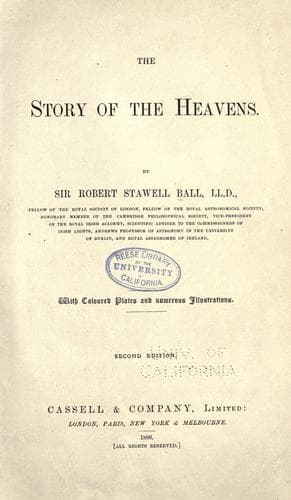
The Story of the HeavensBall, Robert S. (Robert Stawell)
History
The Story of the Heavens
Ball, Robert S. (Robert Stawell)
Astronomy
Even if this difficulty could be removed, there is still another, which
would be quite insuperable if the ring be composed of any materials with
which we are acquainted. Let us ponder for a moment on the matter, as it
will lead up naturally to that explanation of the rings of Saturn which
is now most generally accepted.
Imagine that you stood on the planet Saturn, near his equator; over your
head stretches the ring, which sinks down to the horizon in the east and
in the west. The half-ring above your horizon would then resemble a
mighty arch, with a span of about a hundred thousand miles. Every
particle of this arch is drawn towards Saturn by gravitation, and if the
arch continue to exist, it must do so in obedience to the ordinary
mechanical laws which regulate the railway arches with which we are
familiar.
The continuance of these arches depends upon the resistance of the
stones forming them to a crushing force. Each stone of an arch is
subjected to a vast pressure, but stone is a material capable of
resisting such pressure, and the arch remains. The wider the span of the
arch the greater is the pressure to which each stone is exposed. At
length a span is reached which corresponds to a pressure as great as the
stones can safely bear, and accordingly we thus find the limiting span
over which a single arch of masonry can be constructed. Apply these
principles to the stupendous arch formed by the ring of Saturn. It can
be shown that the pressure on the materials of the arch capable of
spanning an abyss of such awful magnitude would be something so enormous
that no materials we know of would be capable of bearing it. Were the
ring formed of the toughest steel that was ever made, the pressure would
be so great that the metal would be squeezed like a liquid, and the
mighty structure would collapse and fall down on the surface of the
planet. It is not credible that any materials could exist capable of
sustaining a stress so stupendous. The law of gravitation accordingly
bids us search for a method by which the intensity of this stress can be
mitigated.
One method is at hand, and is obviously suggested by analogous phenomena
everywhere in our system. We have spoken of the ring as if it were at
rest; let us now suppose it to be animated by a motion of rotation in
its plane around Saturn as a centre. Instantly we have a force developed
antagonistic to the gravitation of Saturn. This force is the so-called
centrifugal force. If we imagine the ring to rotate, the centrifugal
force at all points acts in an opposite direction to the attractive
force, and hence the enormous stress on the ring can be abated and one
difficulty can be overcome.
Public-domain text, read in full here on John Shaqi.
Reviews
Reviews
No reviews yet
Be the first to share your thoughts on this work.
Elsewhere in the archive
Join the Discussion
Join the discussion
Sign in to leave a comment or review.
Sign InorCreate an account